


Most 'AI projects' are 60-70% automation.
Deterministic automation and probabilistic AI are two halves of the same engagement. PRESHai builds both: workflow automations the agent invokes when the task is rule-shaped, and MCP connectors the agent reasons over when the task needs judgment. One platform, one governance model, one audit log.
THE REAL SHAPE OF AI WORK
Probabilistic where it matters. Deterministic everywhere else.
Buyers come to us asking for AI. After scoping, the honest answer is usually that 60-70% of the work is automation that doesn't need a model to run, and the rest is genuinely agentic. The mistake most firms make is forcing every workflow onto the AI side of that line and paying tokens for things that should be a pipeline.
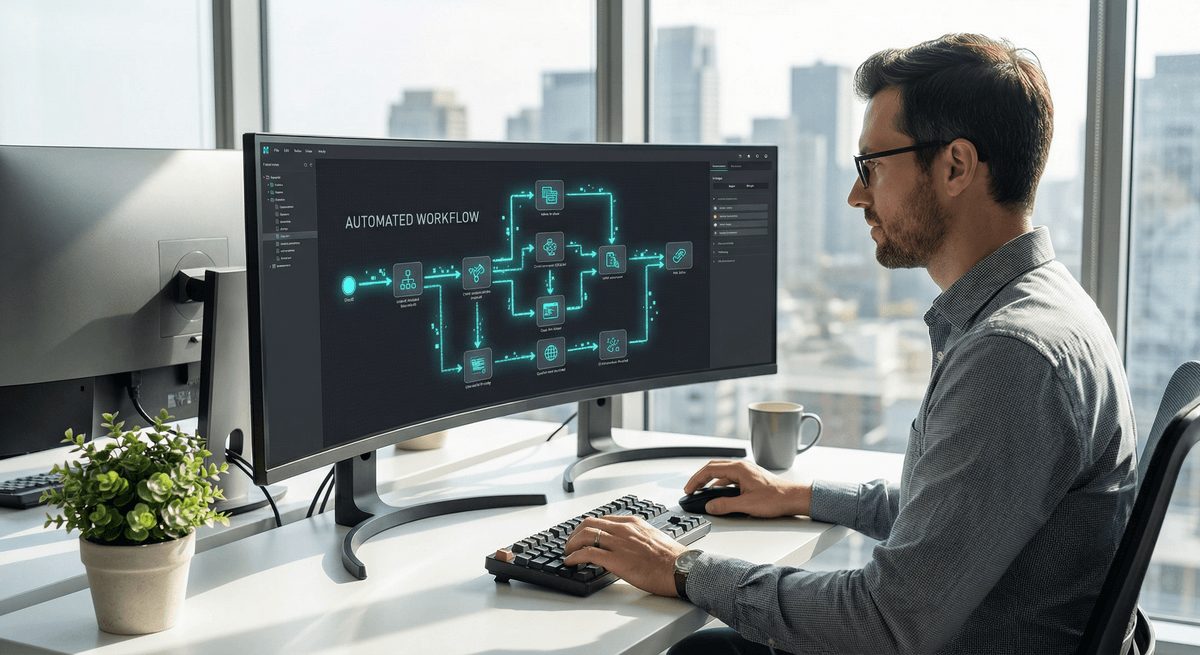
We build the integration layer that supports both. Deterministic automations the agent invokes when the rules are clear. MCP connectors the agent reasons over when the task needs judgment. Both ship into the Agent Ops module of PRESHos and live in your tenant under one governance model.
HOW IT WORKS
Deterministic automation and agentic AI, governed together.
Deterministic automations
Rule-shaped work belongs on a deterministic pipeline. Same inputs, same outputs, every time. No model variance, no token cost, no audit ambiguity. We build these as workflow automations the agent can invoke when the task is rules-clear.
Agent-callable integrations
Judgment-shaped work belongs on an agent. We build MCP connectors per engagement and integrate them into the Agent Ops module of PRESHos. Each connector is a reusable interface between the agent and a system of record, not a one-off script.
One engagement, both patterns
We don't pick a side. The right answer for most channel work is some of each. The engagement decides which pattern fits which workflow, and the integration layer supports both inside the same governance model.
Audited and governed
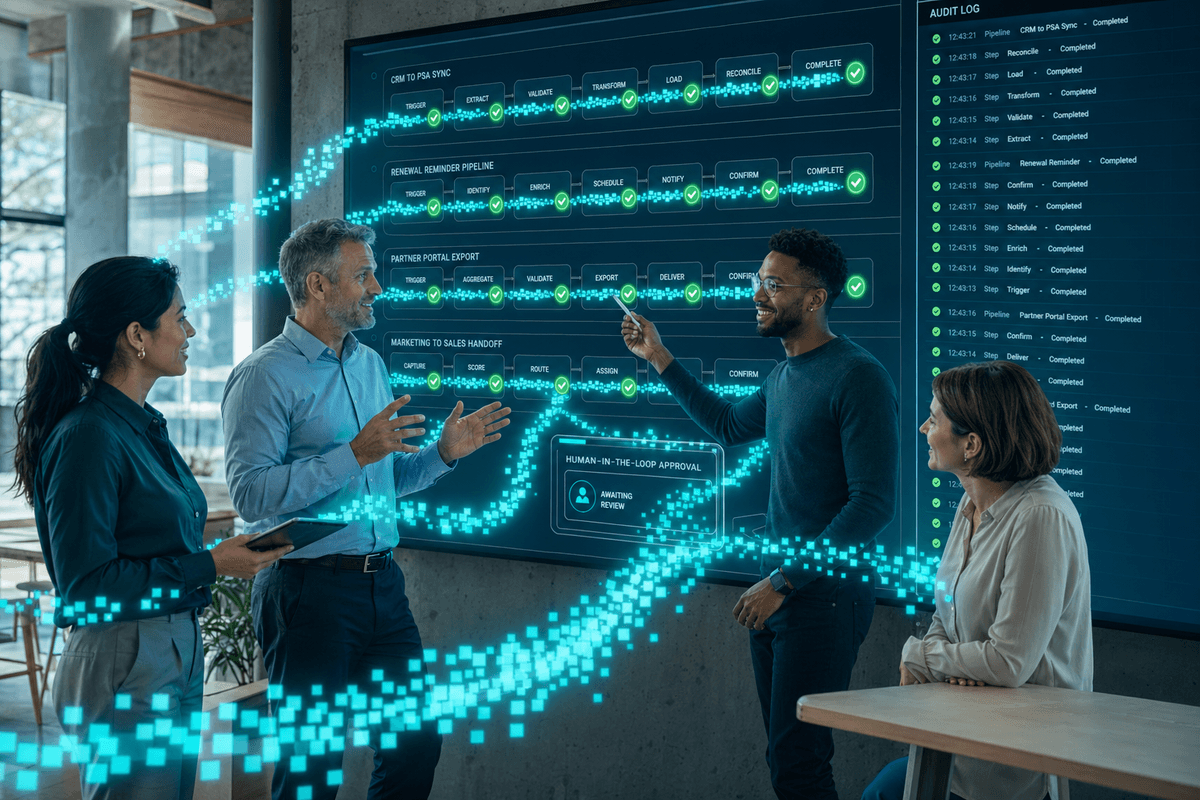
Every action is logged with the human invoker, the agent, the input, the output, and the actor identity that hit the upstream system. Writes route through HITL gates. The digital-twin sandbox lets the agent reason at full speed across reads while writes stay safe.
WHERE DETERMINISTIC ENDS, AGENTS BEGIN
100% workflow automation, with trust behind it.
Deterministic workflow automation is the unglamorous core of how a business actually runs: the CRM-to-PSA handoff, the ticket sync, the renewal reminder, the partner-portal export. Done well, it runs every day without anyone noticing. Done partially, it leaves a tail of edge cases someone is supposed to clean up by hand and usually doesn't.
AI changes the unit economics of that tail. The malformed record, the unexpected status, the partner that named the field something nobody else uses, the contact that came in spelled three different ways. The agent closes the gap that deterministic logic was never going to cover. The deterministic spine and the agent-handled outliers together get you to 100% automation with audit and trust behind it, instead of 80% automation and a dashboard of exceptions someone is supposed to clear.
PLATFORMS WE'VE INTEGRATED
INTEGRATION AS AN ASSET
Each connector is designed before it lights up.
The read surface, the write surface, the credentials, the audit hook, the rate-limit envelope, the failure-mode behavior, and the HITL gate on writes. Designed once, reusable across the program.
The result is integration as a compounding asset, not a one-off script that breaks the next time an upstream API changes. Org data is mirrored into a digital twin so the agent runs at full speed across reads, joins, and reasoning. Human-in-the-loop gates initiate the create, update, or delete against the real system. Speed and safety stop being a tradeoff.


Bring us the workflow. We'll tell you which half it belongs on.
Most engagements ship more deterministic automation than the buyer expected and more agent reasoning than they thought possible. We size both honestly, in scope.