PRESHaiPRESHai
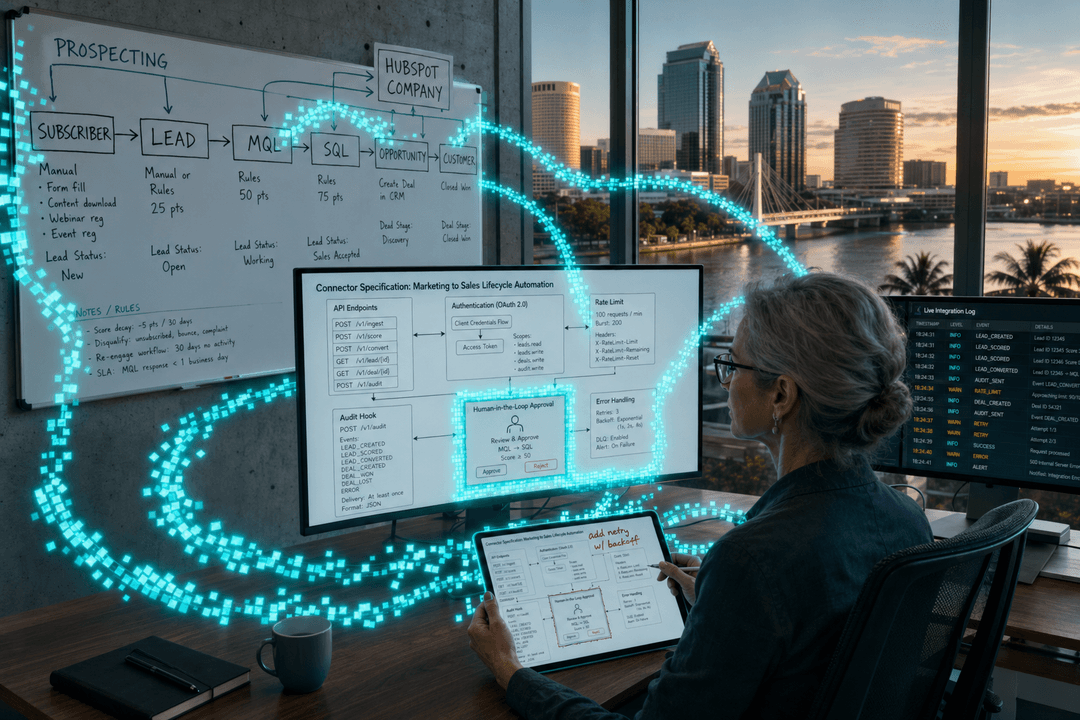
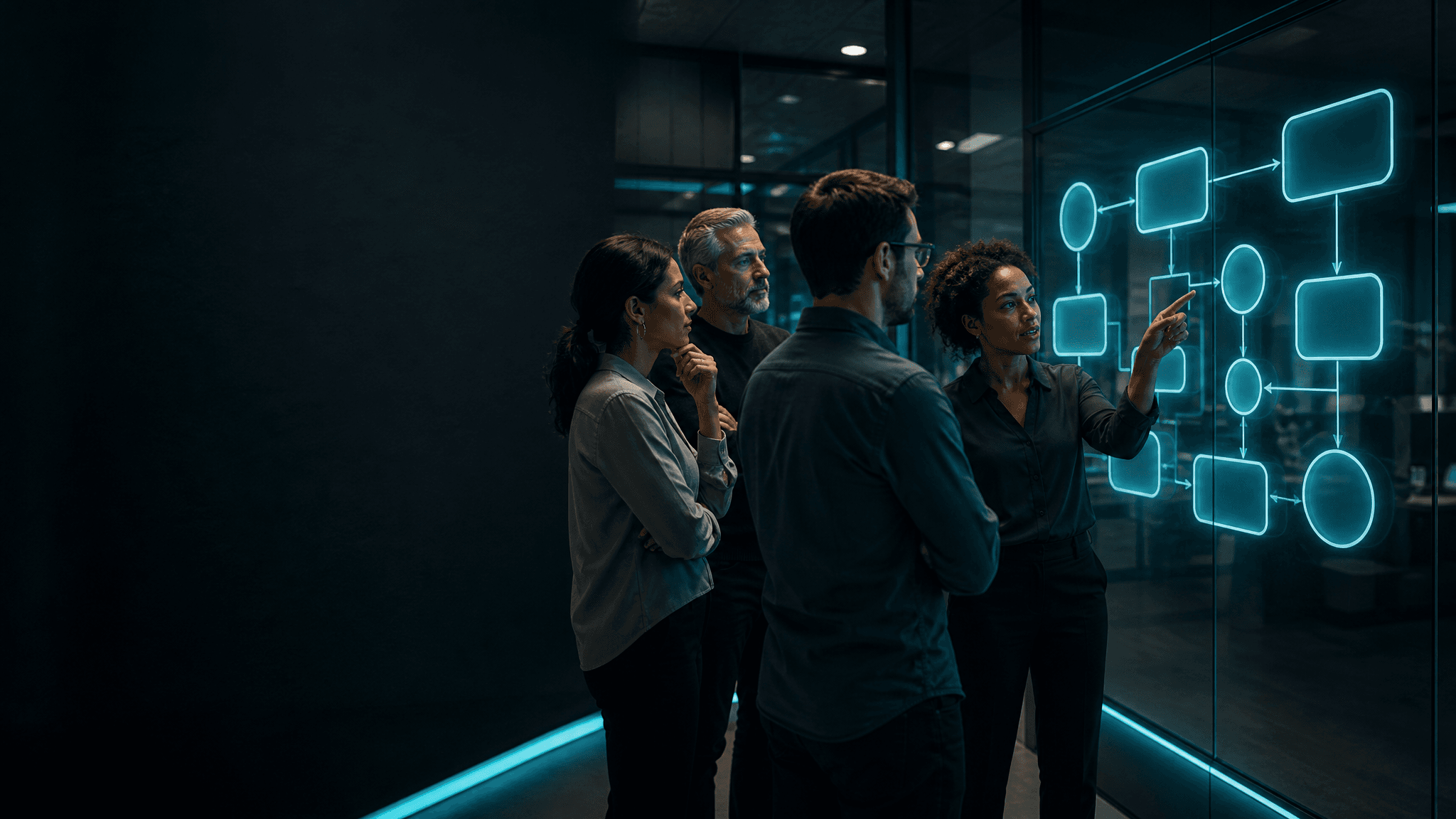
A pair of professionals at a glass conference wall sketching abstract AI system architecture with blue marker, with cyan pixel data particles scattered through the room.

Production-grade AI for the IT channel.

PRESHai stands up the strategy, the platform, the integrations, the controls, and the team ownership that put AI to work inside your channel business.

WHAT WE DO

We build the AI operation that runs your business.

PRESHai is the team that takes AI from idea to a system your business actually runs on. We design the strategy, stand up the platform on PRESHos, integrate it with the systems you already operate, build the governance that lets it run in production, and train the people who own it after we leave.

By the time we are done, AI is not a deck or a pilot. It is part of how your channel business works, with named owners, audited controls, and a roadmap leadership can defend.

Pixel-art split-screen contrasting scattered disconnected pieces on the left with the same pieces connected into a unified system on the right.

WHAT TO EXPECT

How an AI implementation engagement runs.

These are the phases of our AI implementation process. Each phase produces a defined deliverable, sets up the next phase, and contributes to the operational system you exit with. Skim here. Read deeper below.

01

Strategy

Channel ontology, workflow inventory, phase-one scope.

02

Platform

PRESHos tenant configured, agent factory templates ready.

03

Integrations

Connectors specced, invoker-on-log audit, MCP plus deterministic patterns.

04

Governance

Approval routing, evaluation rubrics, escalation runbooks.

05

Enablement

Champions trained, role curricula delivered, ownership transferred.

Pixel-art icon depicting an interconnected ontology with nodes and edges dispersing into cyan particles.
01
STAGE 01 — STRATEGY

Strategy and ontology.

Every AI implementation that survives in production starts with a strategy phase that maps the business, not the model. We inventory the workflows that touch revenue or risk, score them by AI fit and impact, and translate that into a sequenced phase-one scope leadership can fund.

The deliverable from strategy is not a deck. It is a channel ontology that defines how the business actually works in entities and relationships, so every later stage builds on the same map. Without the ontology, agents end up answering questions the business does not ask in language the business does not use.

  • Channel ontology covering entities, relationships, and governance edges
  • Workflow inventory with AI fit and business-impact scoring
  • Phase-one workstream plan with named owners and exit criteria
  • CFO-ready scope and engagement brief
02
STAGE 02 — PLATFORM

Platform: PRESHos.

PRESHos is the platform agents run on. It is the substrate every later stage builds on. Where a generic AI consultancy hands you a stack of vendors and walks away, PRESHai stands up your tenant of PRESHos and configures the agent factory, runtime, observability, and integration layer to your business.

Inside the platform, agents are built (factory), orchestrated against your workflows (runtime), evaluated against business outcomes (observability), and connected to your operating systems (integration). One platform, one evaluation harness, one observability layer. The eleventh agent costs less than the second.

  • Agent factory configured with templates for your priority workflows
  • Runtime and orchestration layer running agents against governed paths
  • Observability dashboards and evaluation rubrics live before launch
  • Integration layer reading and writing across your stack with audit
Pixel-art icon depicting a stacked four-layer platform architecture in cyan, with dispersing pixel particles around the edges.
Pixel-art icon depicting an integration hub with connector arms reaching outward, dispersing into cyan particles.
03
STAGE 03 — INTEGRATIONS

Integrations and connectors.

Agents are only as useful as the data and tools they can reach. The integrations stage connects the stack you already operate, PSA, RMM, CRM, ITSM, SIEM, ticketing, and the system of record, so agents read context, reason, and act through governed paths.

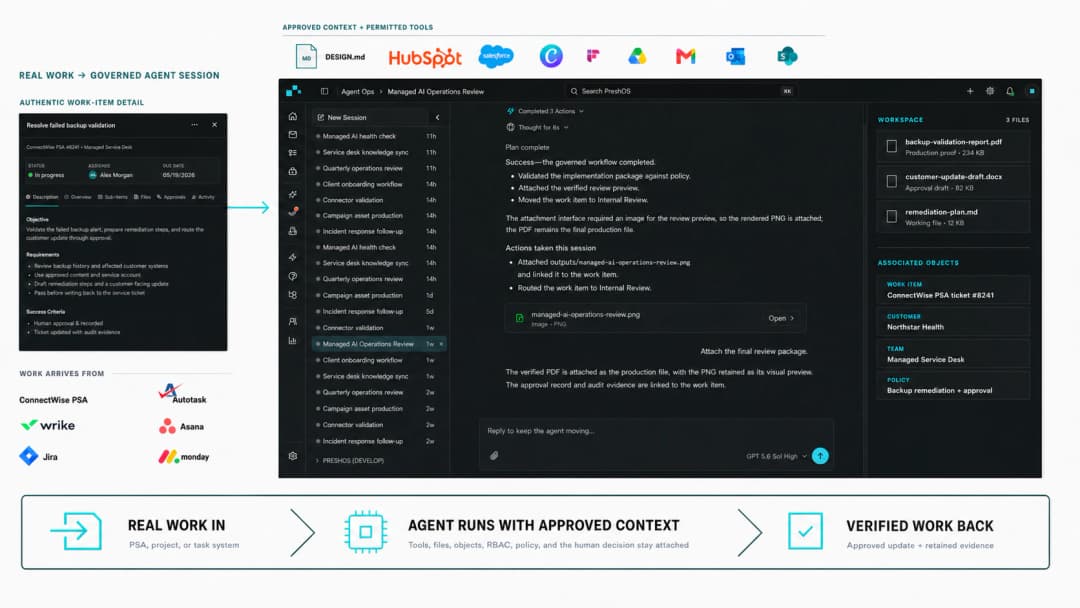
Every connector is scoped before it lights up. Read versus write paths reviewed, the human invoker recorded on every agent action inside PRESHos, and the actor identity that hits the upstream system inheriting the invoker's permissions. If the human cannot create a deal in ConnectWise, the agent cannot either. Org data mirrored into a digital twin where the agent runs at full speed, with the HITL gate initiating any create, update, or delete against the real system.
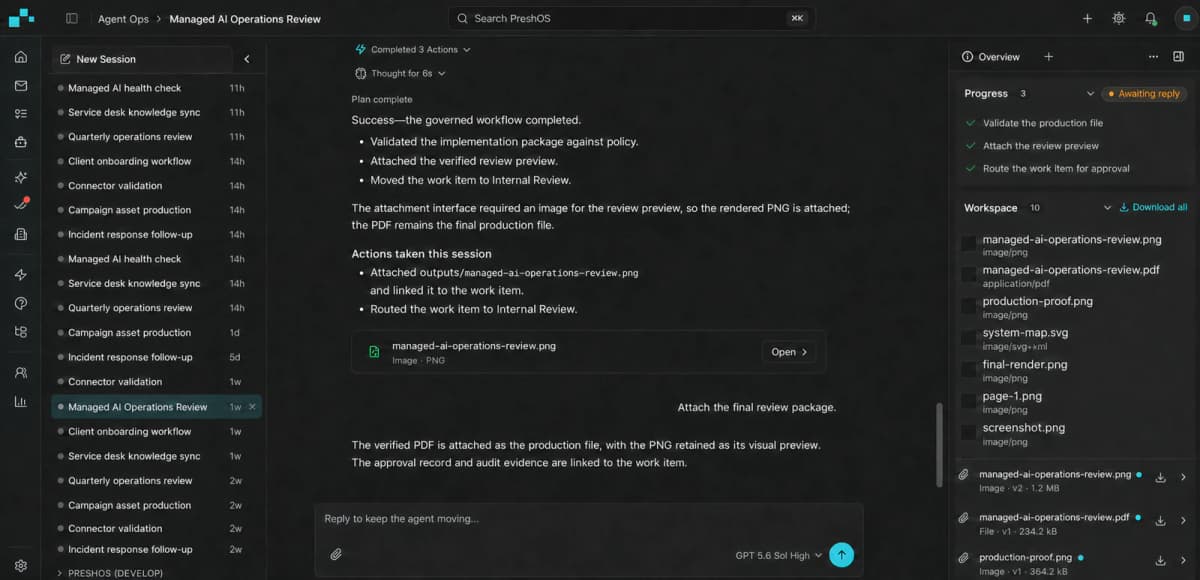
  • MCP connectors and deterministic automations into the Agent Ops module of PRESHos
  • Invoker-on-log audit: human invoker, agent, and inherited permissions recorded on every action
  • Digital-twin sandbox plus HITL gate on writes to the systems of record
  • Integration runbooks the operations team can run themselves
04
STAGE 04 — GOVERNANCE

Governance, controls, and human-in-the-loop.

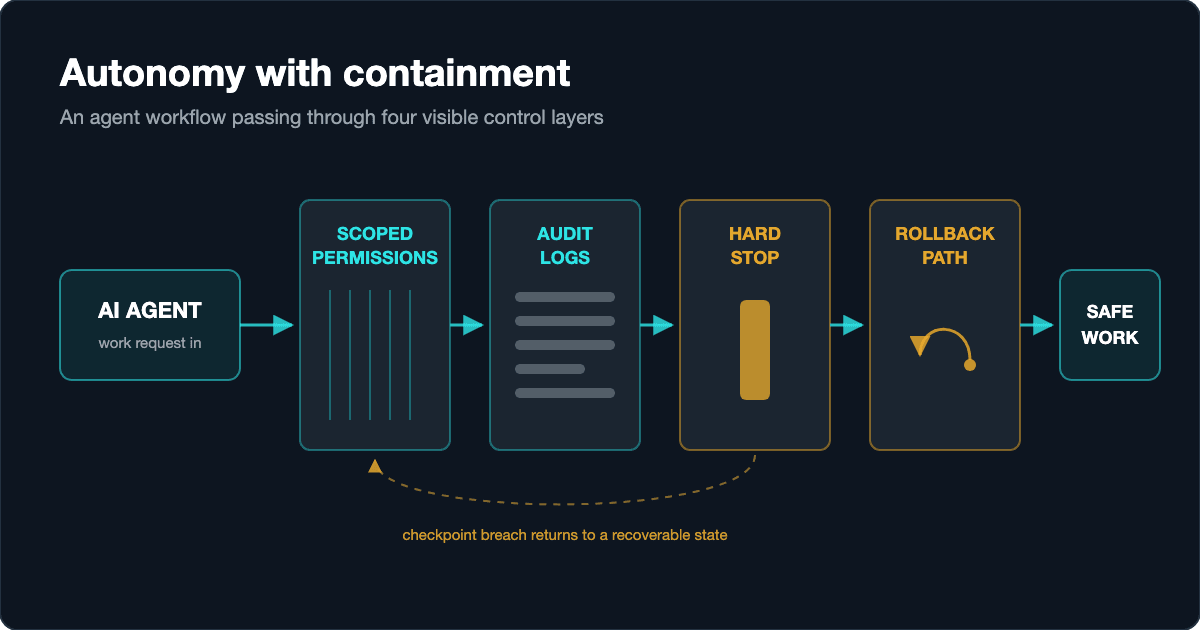
Production agents need approval routing per risk class, evaluation rubrics tied to business outcomes, audit logs that survive a CFO question, and escalation paths the CIO can defend. Governance is the discipline that prevents agents from doing things to your business no one signed off on.

ROUTING

Approval routing per workflow risk class.

Low-risk decisions auto-execute. Higher-risk decisions route to the right human with the context they need to decide. Defined per workflow before launch, not retrofitted after the first incident.

EVALUATION

Rubrics tied to business outcomes.

Every governed workflow gets an evaluation rubric written in business language, not model-quality jargon. We measure agents against the operational outcome they should produce, not against vibes.

AUDIT

Logs that survive a CFO question.

Every agent action logged to your existing IT and compliance tooling. Replayable. Decision rationale captured. The auditor's first question has an answer before they ask it.

ESCALATION

Runbooks the CIO can defend.

When agents disagree with a human or hit edge cases, escalation paths route to the right team with context. Rollback procedures defined, tested, and on file before the agent touches a customer.

05
STAGE 05 — ENABLEMENT

Enablement, change, and transfer.

AI implementation does not stick because the platform is good. It sticks because the team using it is ready to own it. The enablement stage runs alongside the back half of build so that by launch, internal champions are identified, workflows are redesigned around agents, and the curriculum that keeps the team current is in place.

Training is role-based and hands-on. Engineering learns the agent build patterns. Operations learns the evaluation and rollout cadence. Practice leads learn workflow ownership. IT and legal learn the governance operations. The team you train is the team that runs the system after the engagement closes.

  • Internal champion identification with named ownership plans
  • Role-based curriculum, hands-on labs, operational runbooks
  • Workflow redesign sessions co-led with practice leads
  • Knowledge transfer plan and post-engagement support window
Pixel-art icon of a skeleton key dispersing into cyan particles, signaling knowledge transfer and handing over the keys.
ONCE IT IS RUNNING

Implementation builds it.
We can keep it sharp.

When the implementation engagement closes, your team owns a working AI operation. From there, many clients retain PRESHai to keep the platform, the controls, and the agent roadmap current as the AI landscape moves, brief leadership on what should ship next, and run the operational disciplines so the system gets sharper, not stale.

MANAGED AI OPS

The discipline that keeps AI sharp.

We manage the PRESHos tenant, run the controls, keep building and optimizing agents, and brief your execs on the recommendations and changes the platform should ship next.

Explore Managed AI Ops

Start with strategy. Or start where the pain is.

Tell us where AI is stalling. We will tell you which stage to start with.