


How PRESHos turns agent work into governed operations.
PRESHos gives every agent a scoped environment, a durable session, reusable skills, governed tools, auditable knowledge, and a runtime that can connect to your operating stack without turning into a black box.
The platform separates what the agent does from what the business must control.
Scope the work, package the capability, run the workflow, gate the risk, and keep the record. Here is how those pieces compose into one operating layer.
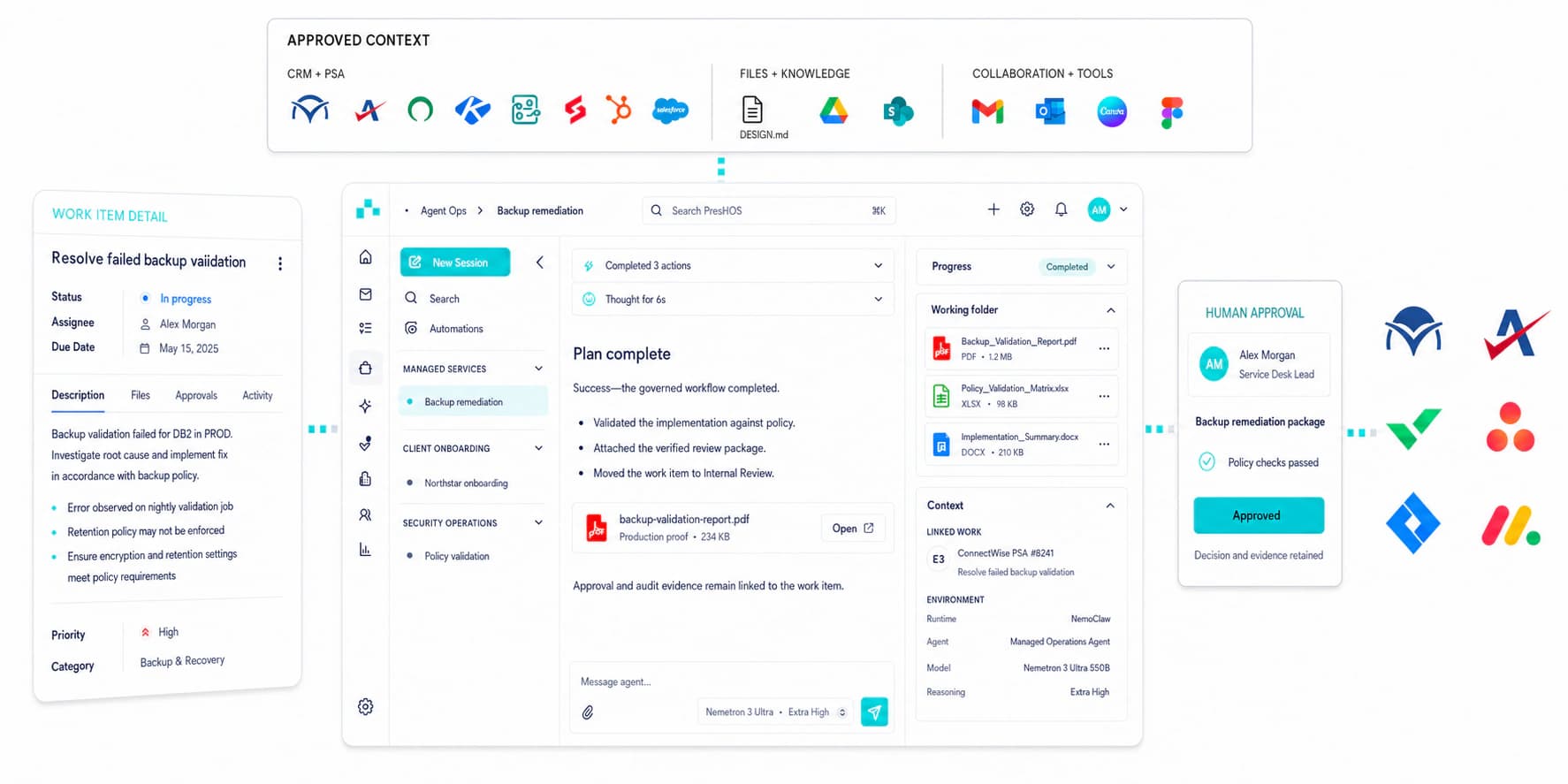
ENVIRONMENTS AND SESSIONS
Every task runs with the right scope and leaves a record behind.
An Agent Environment is the unit of scope. It binds the agent to a repository or sandbox, a knowledge set, secret grants, tool grants, plugin permissions, and the approval policy for the work. The same agent can behave differently by client or workload because the environment changes what it can read, call, and change.
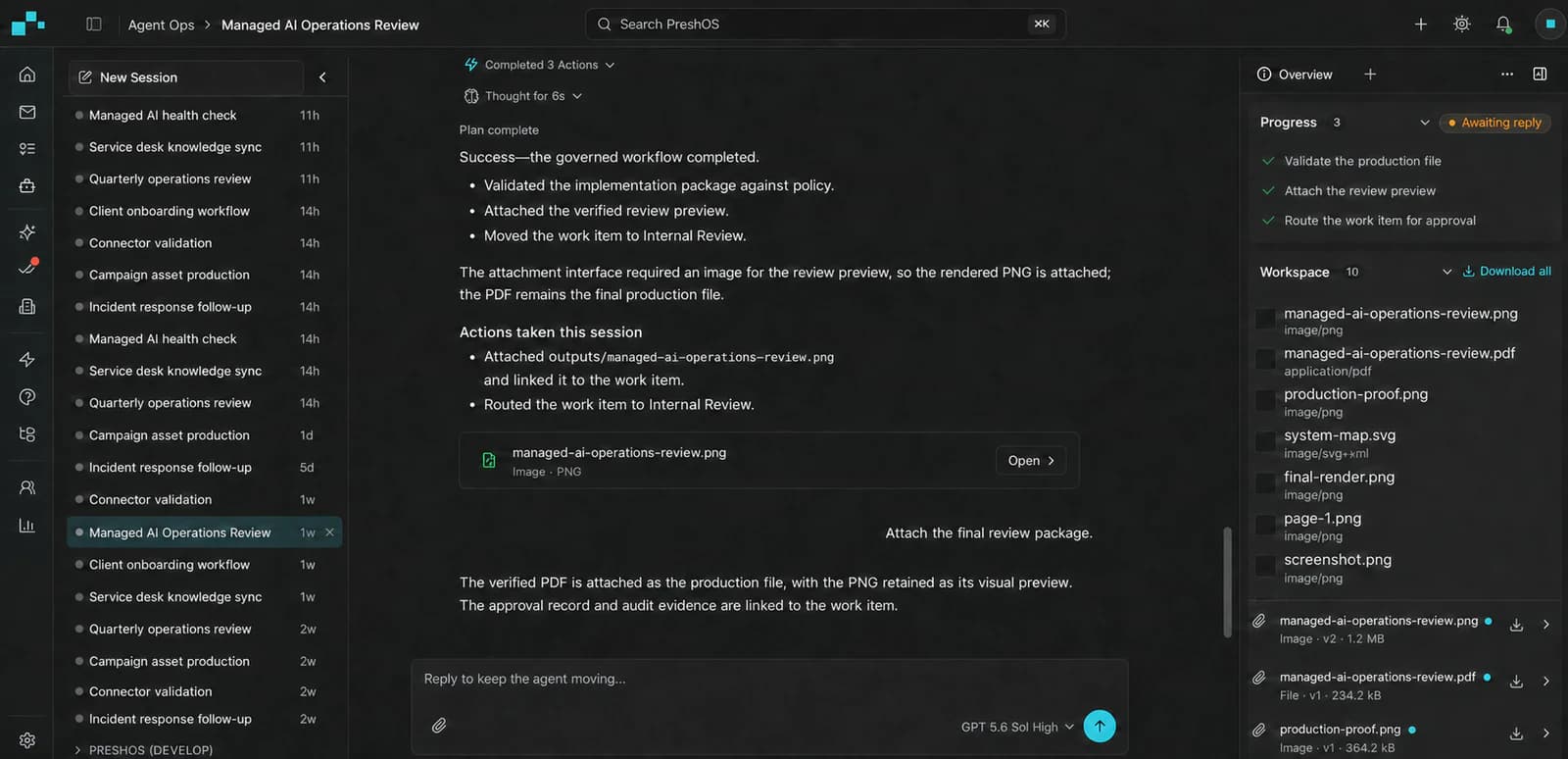
A session is the durable thread for the task. Plans, run events, file changes, sandbox previews, approvals, and reviewer decisions stay together. Operators can open the session, see what happened, steer the work, and continue later without rebuilding context.
- Per-client and per-workload environments keep tools, secrets, and knowledge scoped
- Sessions preserve the plan, run history, diffs, previews, and approval state
- Operators review agent work in one place instead of chasing logs across tools
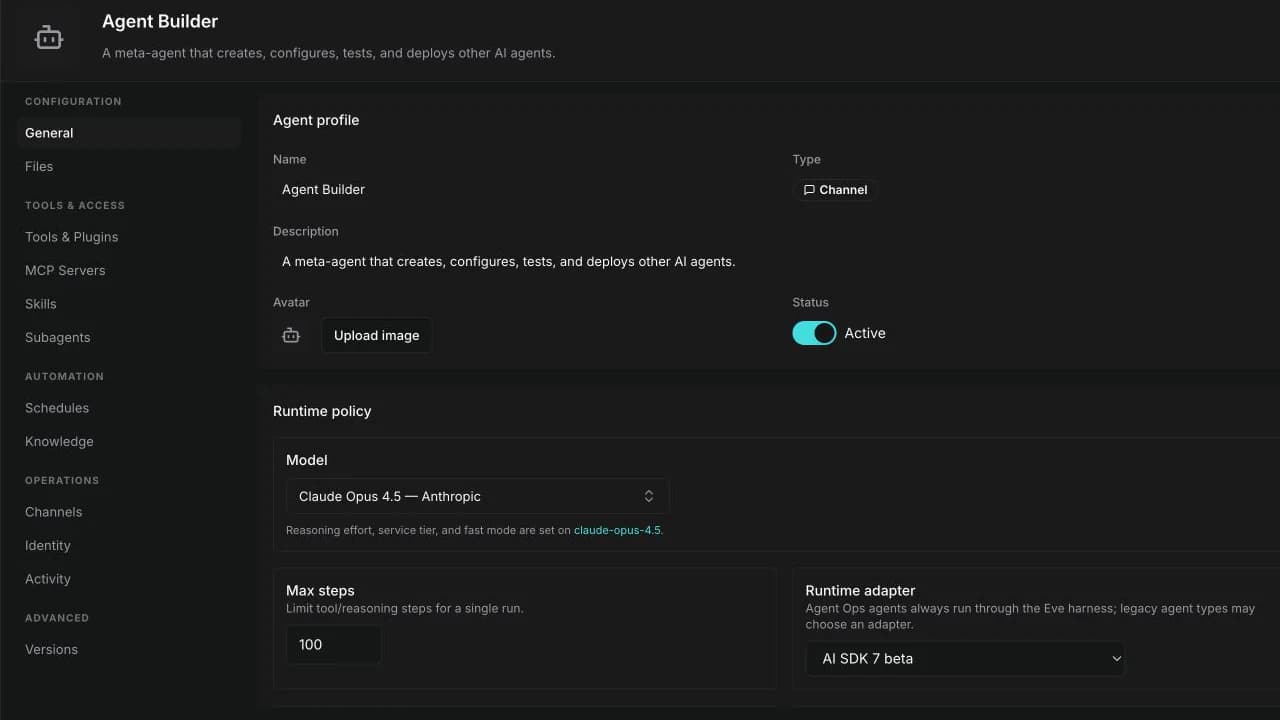
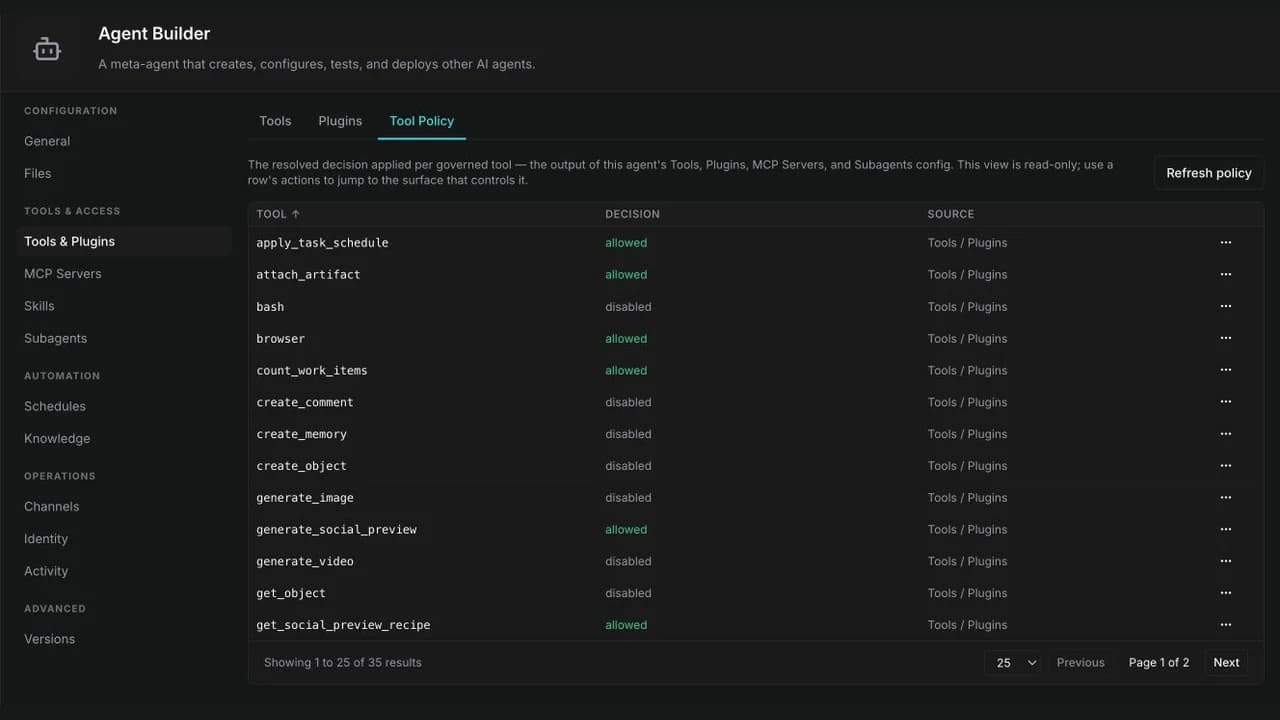
SKILLS, TOOLS, AND KNOWLEDGE
Repeatable work becomes a reusable capability.
Tools are callable actions. Skills package instructions, tool grants, and knowledge attachments into reusable behavior. Capabilities define what the runtime can do. Plugins decide how those capabilities show up in the interface and in the work.
Knowledge is attached where it belongs: to an environment, a skill, or an agent. Retrieval is logged with the query, the returned chunks, and the run that used them, so the team can trace an output back to the source material that informed it.
- Skills carry their grants and knowledge attachments with them
- Agent-level grants handle exceptions without rewriting the skill
- Retrieval is auditable, not just convenient
WORKFLOW ORCHESTRATION
Agents, triggers, tools, and reviewers run in the same operation.
PRESHos workflows start from the systems your team already uses: inbound messages, schedules, project events, and webhooks. Agent nodes handle reasoning steps. Tool nodes call the systems of record. Reviewer nodes pause the work when policy requires a human decision.
The workflow is versioned, testable, and observable. Operators can test a change before it reaches production and watch live runs against the same graph that defines the work.
- Triggers start from real business events, not a separate launcher
- Each step can use the agent, model, tool, or reviewer the work requires
- Workflow changes create a history the team can review
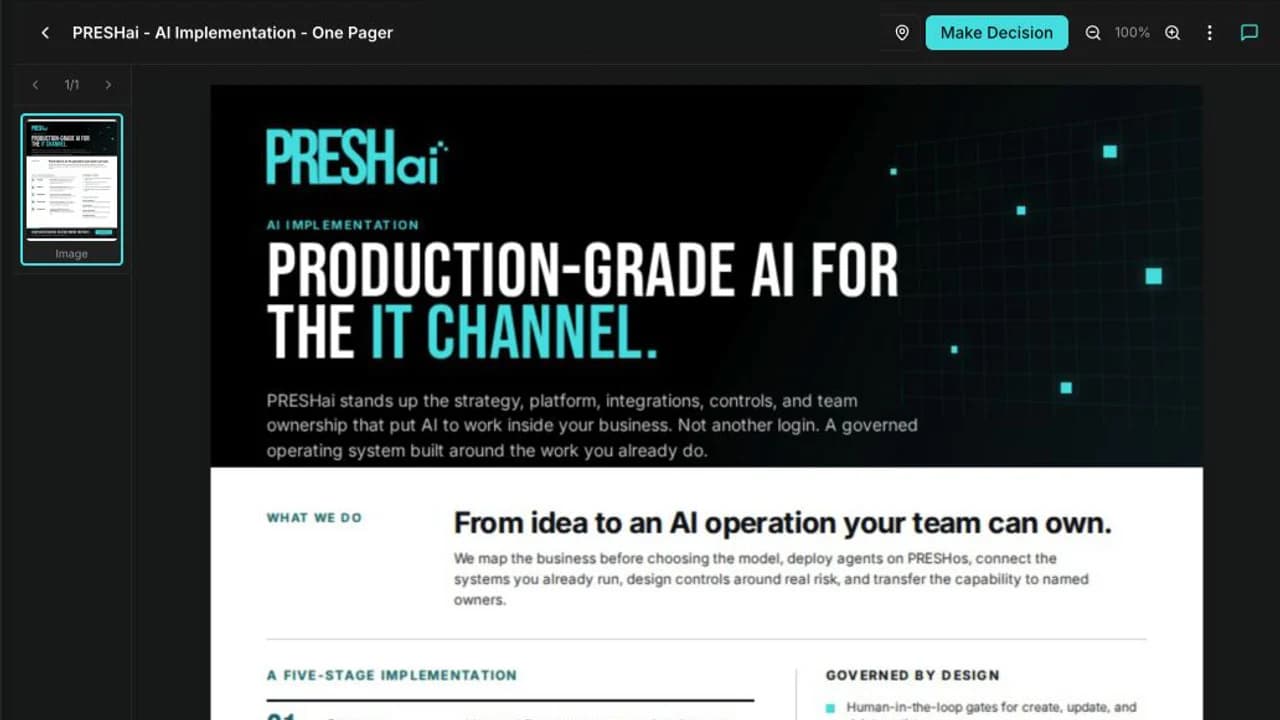
GOVERNANCE AND AUDIT
Policy stops risky work before it ships.
Approval policy lives in the runtime. Each tool grant decides whether an action is blocked, allowed, or paused for human review. When a risky action pauses, the reviewer sees the request, the surrounding context, and the payload or diff before deciding.
Every decision becomes part of the operating record. Approvals, rejections, field changes, run history, usage, and retrieval rows all land where operations and compliance can review them later.
- Human-in-the-loop review is enforced where the action happens
- Reviewers get full context before approving or rejecting the work
- Audit rows are written as the work happens, not reconstructed afterward
RUNTIME AND INTEGRATIONS
The runtime does the work. PRESHos keeps it controlled.
PRESHos owns the durable control plane: sessions, permissions, event persistence, tool grants, approvals, audit rows, and review state. Execution happens in isolated workspaces so agent work can use files, browser checks, shell commands, and generated artifacts without bleeding between clients or runs.
Integrations connect that controlled runtime to the stack you already operate. The same model covers MCP servers, plugin adapters, model access, secret grants, webhooks, and custom tools built during the engagement.
- Durable records stay in PRESHos; execution stays isolated
- Tool access is granted per environment, skill, or agent
- Integrations are fitted to the engagement instead of forcing a generic workflow

See how PRESHos would scope your first workflow.
Bring us the operation you want agents to run. We will show you which environments, skills, tools, approval gates, and integrations it needs.