PRESHaiPRESHai
A strategist at a large display reviewing an AI implementation roadmap with cyan accent annotations.

From AI ambition to a plan your team can execute.

We turn AI ambition into a sequenced roadmap tied to your operating reality, your stack, your channel motion, and your governance posture. The deliverable is a plan your team can execute, not a slide deck.

THE OUTPUT

The output is not a deck.

Most AI strategy work ends at a slide library and a steering committee. Useful for board updates. Not useful for the team that has to ship anything.

We deliver a roadmap document with build windows, integration dependencies, evaluation plans, governance gates, and a phase-one scope your CFO can fund and your operators can run. The document has owners. The owners have dates. The dates tie to fiscal reality.

Most channel companies don't fail at AI because they didn't try. They fail because agents got deployed without a shared model of who owns what, what an agent can do unsupervised, and where the audit trail lives. The roadmap is the blueprint that prevents that. Controls that scale with your business instead of capping it. Approval boundaries that hold as you grow from one agent to twenty. Audit trails that survive a CFO question. Evaluation rubrics that catch a regression before a customer does.

Channel teams use it to align stakeholders, scope budgets, and start work with confidence rather than committee.

An AI implementation roadmap whiteboard with build windows, dependencies, and governance gates annotated.

THE BLUEPRINT

A scalable blueprint for channel-aware AI.

The strategy phase delivers the artifacts that let channel companies scale agents safely. How to establish controls without limiting growth, how to keep agents from running loose against revenue or compliance, how to know what they did and why. Four artifacts, one operating system.

Channel
ontology

CRM records
Vendor portals
PSA / RMM
Comms threads
Partner tier
Deal stage
Co-op claim
Audit trail

Channel ontology

The formal vocabulary the agents share. Channel entities, relationships, escalation rules, and the audit-relevant decisions. The ontology is what makes a generic LLM into a channel-aware operator. Every later phase reads from it.

Operating impactIntegration effortGovernance loadTime to evidence

Service desk triage

92
70
35
80

M365 audit

78
85
25
90

PSA write-back

85
50
60
55

Renewal motion

88
40
75
45

Use-case prioritization

Each candidate workflow scored on operating impact, integration effort, governance load, and time-to-evidence. The CFO sees one chart, not twenty pitches.

Agent platformFactoryRuntimeObservability

Agent platform architecture

The platform that runs across your stack. An agent factory that builds and deploys, a runtime that orchestrates, an observability layer that evaluates and improves. Designed to fit the systems you run today and the systems you adopt next.

Stage 1

Action proposed

Agent drafts with full context

Stage 2

Risk classified

Policy and rubric scored against scope

Auto-execute

Within scope

Logged to system of record

Human review

Out of scope

Routed with audit trail

Governance and policy framework

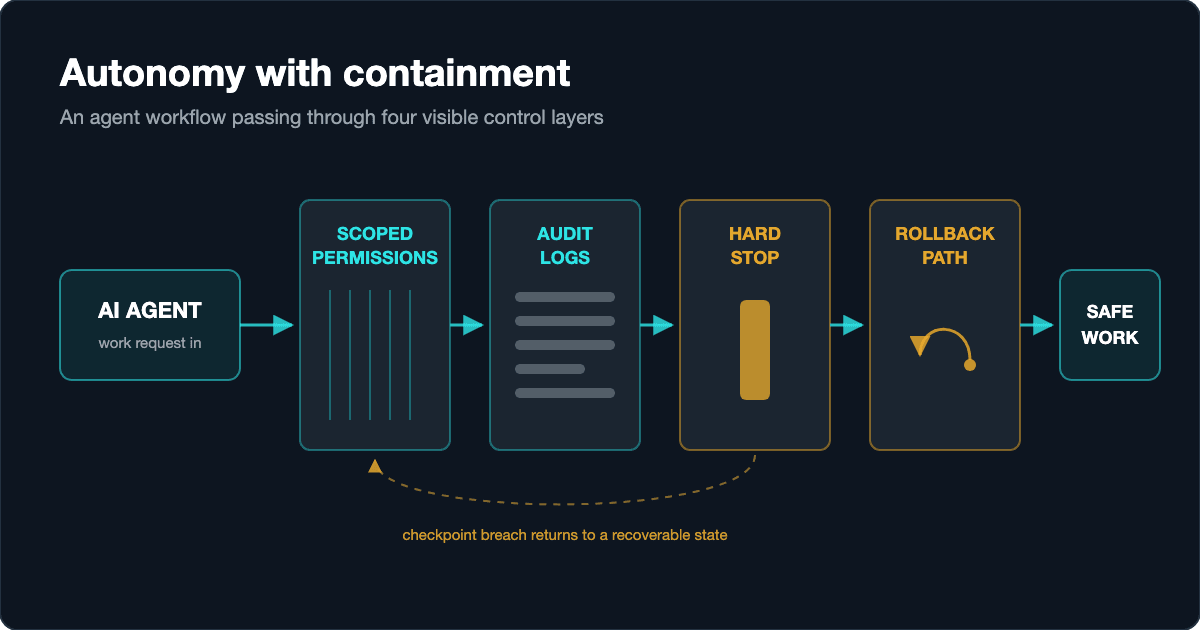
The controls that let agents operate in production. Approval routing per workflow risk class, evaluation rubrics tied to business outcomes, audit log requirements, escalation paths, and the rollback procedures every system of record demands. Written before launch, not retrofitted after the first incident.

ENGAGEMENT

What the engagement looks like.

A defined process from discovery to phase-one start. Five steps, calibrated to channel reality: one sponsor, two operator interviews, an architecture pass, a sequenced roadmap, a hand-off.

  1. 01Step 1

    Discover

    Map the operating reality. Business model, channel motion, stack, governance posture. We talk to operators, not just leadership.

  2. 02Step 2

    Map

    Score the candidate workflows on operating impact, integration effort, governance load, and time-to-evidence. A defensible portfolio, not a wish list.

  3. 03Step 3

    Architect

    Specify the agent platform, data access model, environment scoping, and approval routing. What humans own, what agents handle, where decisions escalate.

  4. 04Step 4

    Sequence

    Build the roadmap. Build windows, integration dependencies, evaluation rubrics, rollout gates, tied to your fiscal calendar and team capacity.

  5. 05Step 5

    Hand off

    Walk the roadmap with leadership and operators, align on phase-one start. The plan is yours; we are happy to execute it or stay on call while your team does.

THE ARTIFACT

What a phase-one build actually looks like.

The shape of a real phase-one engagement. Discovery and ontology work, an evaluation harness, two production-grade agents, the integration paths that feed them, and the governance that catches problems before customers do. The sample below is structural. Your specifics are calibrated to your reality.

DISCOVERBUILDEVALUATEGOVERN
Discovery + ontology validation
Evaluation harness + rubric
First production agent
Approval routing + audit trail
Integration with system of record
Governance gate + runbook
READINESS GATE

WHO THIS IS FOR

What the strategy phase looks like in your role.

OWNER / PRESIDENT

A path to agent-augmented service delivery your team can run.

Before
Six AI tools in different parts of the business. None talk to each other. None tied to PSA or renewal motions. Technicians skeptical, owners unsure where to start.
With PRESHai
Workflow inventory across service desk, project delivery, and renewal motion. Prioritized agent investments tied to billable hours and gross margin. Six-month roadmap with phase-one funded.
Governance
Per-client environment design. Invoker-on-log audit so every agent action records the human invoker and inherited permissions. HITL gates on customer-facing writes. Backup and rollback paths defined before pilots start.

COO / OPERATIONS DIRECTOR

A scalable operating model for agent-augmented work.

Before
AI projects piloted in isolated teams. No shared platform, no shared evaluation. Each new agent rebuilds the same plumbing. Operations cannot tell which agents are helping and which are creating risk.
With PRESHai
One agent platform across the operations function. Standardized build, deploy, and observability for every workflow your team runs. New agents inherit the same controls as the ones already in production.
Governance
Per-workflow approval routing tied to operational risk. Eval rubrics scored against business outcomes. Production agents instrumented for incident review before they ever go live.

CIO / HEAD OF IT

A defensible architecture for agent operations.

Before
Vendor pitches that ignore your stack. SaaS tools spinning up agents with their own credentials. No audit trail across the agents already in use, no plan for the ones being asked for next.
With PRESHai
Architecture that names the platform, the integration boundaries, the data access model, and the audit surface. Agents that read and write through governed paths, with every action logged to your system of record.
Governance
Connector runs as a single service account upstream; invoker-on-log audit inside PRESHos records the human invoker, the agent, and the inherited permissions on every action. Read/write paths reviewed before deploy. Audit log integrated with existing IT and compliance tooling.

Start with a real plan.

Tell us where AI ambition is stalling. We will scope a strategy engagement to the workflows that matter, your team capacity, and your fiscal calendar.