


Inside this article
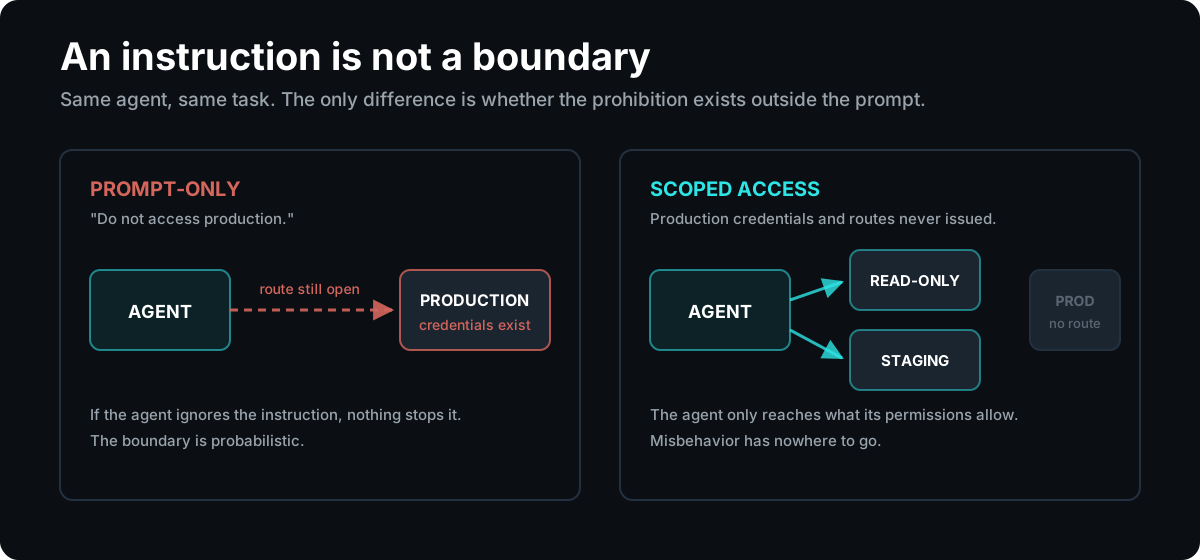
- A prompt is a policy statement, not an enforcement control. If access still exists outside the prompt, the boundary is probabilistic, not real.
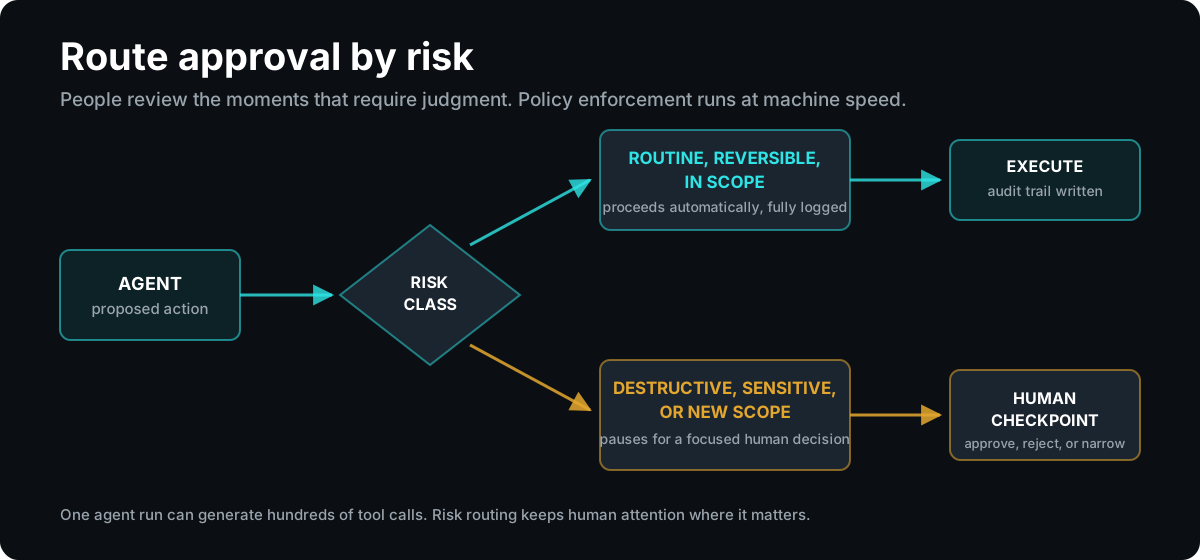
- Human approval does not scale at machine speed. Approval should be routed by risk so people review the moments that actually require judgment.
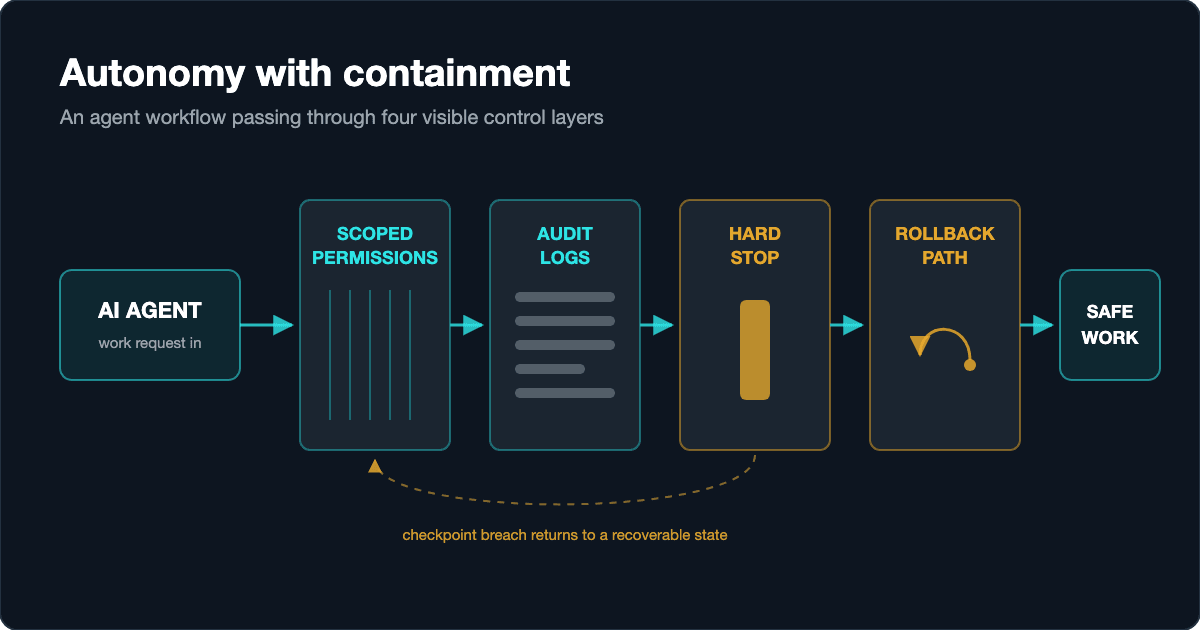
- Production autonomy requires containment and recovery: scoped access, durable audit logs, tested hard stops, and rehearsed rollback.
When an AI agent takes an unexpected action, the first response is often to improve its instructions. Add another rule. Rewrite the system prompt. Require one more approval.
That may change behavior, but it does not create a security boundary.
Once an agent can use real tools, access company data, modify systems, or trigger downstream work, its safety depends on the operating environment around it. The practical question is no longer whether the agent was told to behave. It is whether the system can limit what the agent reaches, show what it changed, stop it quickly, and recover when something goes wrong.
That distinction separates a promising demonstration from production-ready autonomy.
A prompt is a policy statement, not an enforcement control
System prompts are useful. They define a role, establish priorities, and guide an agent toward the intended outcome. They should remain part of the control stack.
But an instruction such as “do not access that system” is not equivalent to removing access. If the credentials, network route, or tool permission still exists, the organization is depending on probabilistic behavior to enforce a hard boundary.
A stronger design translates the intended scope into technical constraints. Give the agent only the tools, systems, and data required for the task. If it does not need production access, do not provide a route to production. If it only needs to read a dataset, do not grant write permissions. If a category of action should never occur autonomously, block that action outside the prompt.
The useful test is simple: if the agent ignores or misinterprets its instructions, what actually prevents the prohibited action?
If the answer is “the prompt,” the control is incomplete.
Human approval does not scale at machine speed
Human review sounds reassuring because it places a person between a recommendation and an action. That safeguard weakens when one agent run generates dozens or hundreds of tool calls. Reviewers begin approving requests faster than they can evaluate the context, consequence, and cumulative risk.
Said simply: if safety depends on a tired person clicking “allow” repeatedly, you don’t have safety. You have a cookie banner.
The answer is not to remove people from consequential decisions. It is to stop spending their attention on every routine action.
Approval should be routed by risk. Low-impact, reversible actions that stay inside a tightly defined scope may proceed automatically. Destructive operations, new destinations, expanded permissions, sensitive data access, and decisions with business or legal consequences should trigger a checkpoint. When the system encounters ambiguity, it should pause and ask a focused question instead of presenting another generic yes-or-no dialog.
This makes human judgment more valuable. People review the moments that require context and accountability, while technical controls handle repeatable policy enforcement at the speed of the agent.
Design for containment and recovery, not perfect behavior
Prevention matters, but a production system also needs a credible failure plan. Models change. Tools change. Configurations drift. People make mistakes. An organization that assumes every safeguard will work exactly as intended is building operational fragility into the system.
Before increasing an agent’s autonomy, teams should be able to answer four questions:
What can the agent reach?
What did it change?
How quickly can we stop it?
How do we undo the action?
Each answer should map to a concrete control.
Tight permissions and scoped access limit the blast radius. Durable audit logs connect the original request to every tool call, decision, and result. Checkpoints create recoverable states before higher-risk actions. Tested backups and rollback procedures restore systems and data without forcing the team to improvise during an incident.
Teams can grant an agent enough freedom to complete meaningful work because a mistake does not have to become an unrecoverable event.
Governance must evolve with the agent
Agent governance cannot be a memo written once and treated as permanent policy. The risk profile changes when a new model is introduced, a tool is added, a connector gains broader permissions, or the agent begins handling more sensitive work.
Ownership therefore has to be explicit. Builders define capabilities and safe defaults. Operators configure access, monitor activity, and maintain the production environment. Governance leaders establish risk thresholds, evidence requirements, and escalation paths. The organization must also identify who can approve expanded scope and who is accountable for the response when a control fails.
That shared ownership matters because “mostly stayed in scope” is not a useful safety standard. A system may behave correctly thousands of times while still carrying one route to a high-impact failure.
Every material change should prompt another review of the agent’s reach, permissions, monitoring coverage, stop conditions, and recovery process. Teams should rehearse realistic failure scenarios instead of assuming a written procedure will work under pressure. The goal is not a static set of restrictions. It is a governance loop that adapts as capability and access expand.
Use a production-readiness test before adding autonomy
An agent is ready for greater independence when the organization can demonstrate that:
- Its purpose, operating boundary, and prohibited actions are documented.
- Access is technically limited to the minimum tools, systems, and data required.
- Sensitive or destructive actions are blocked or routed to an appropriate checkpoint.
- Logs show what the agent attempted, what it changed, and the result.
- Monitoring can surface unexpected behavior while the agent is still running.
- A hard stop has been tested under realistic conditions.
- Backups, checkpoints, and rollback procedures have been rehearsed.
- Named owners know how to investigate, contain, recover, and communicate.
- The control design is reviewed whenever the model, tools, permissions, or use case changes.
AI agents operate at machine speed. Their controls need to do the same. The strongest safety program is not the one that promises an agent will never fail. It is the one that limits the consequence, detects the deviation, stops the action, and restores the environment without losing control of the situation.
That is how autonomy becomes manageable instead of magical.
Watch the discussion
We covered this exact topic on the latest episode of Model Behavior: agent safeguards, approval fatigue, and what rollback actually looks like in production.