Inside this article
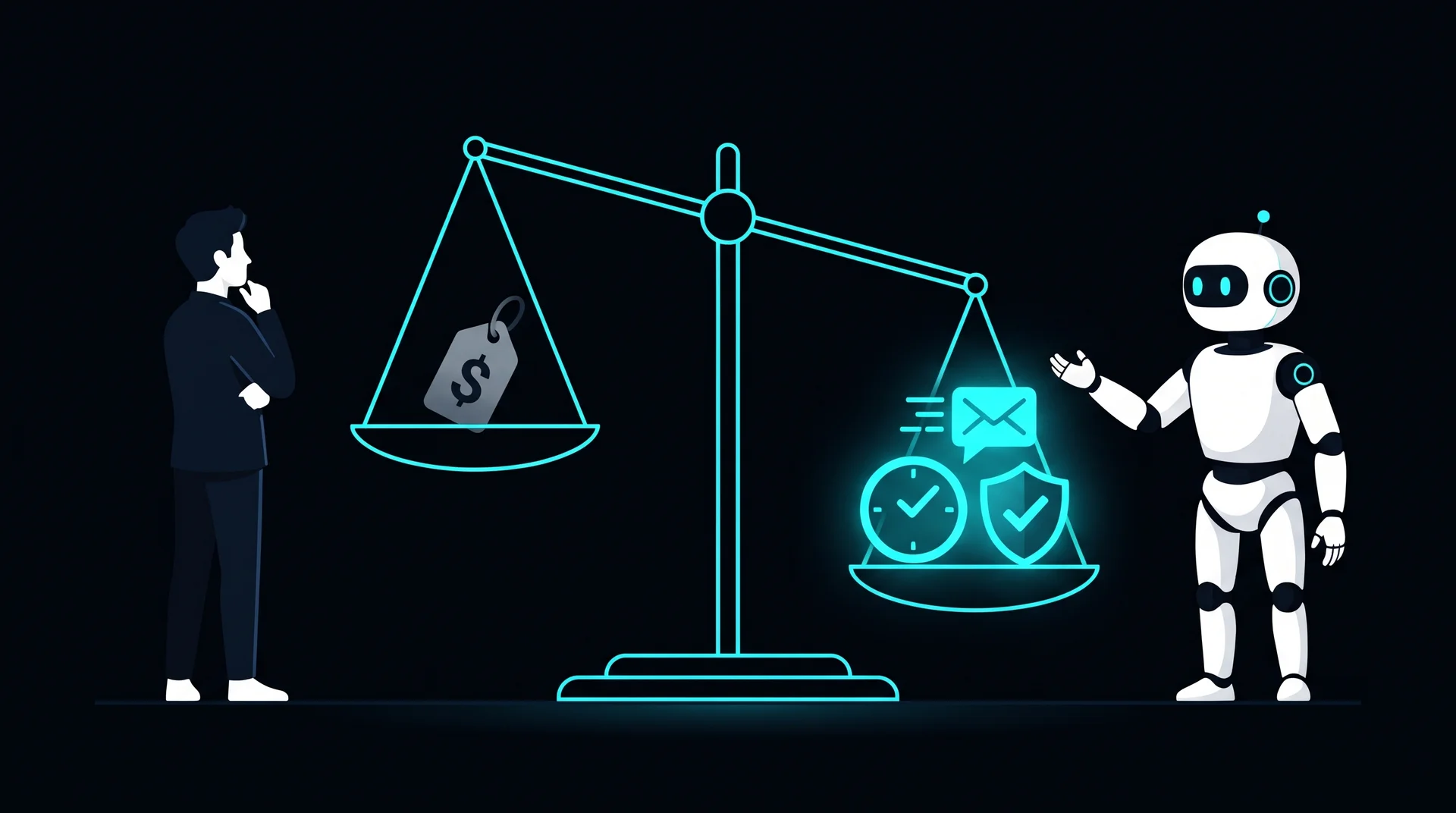
- The question that matters is not what AI consulting costs but whether it pays back. A project that reclaims hours, speeds up responses, and cuts errors justifies its price. A cheap project nobody adopts costs more than it saves.
- Cost varies with scope and complexity, so judge a proposal by what it includes beyond the build: data preparation, training, adoption support, and post-launch care.
- The fastest way to a real number is a discovery call, where a consultant maps your workflows and tells you what return to expect.
Every small-business owner researching AI lands on the same question: how much does AI consulting cost? You have a budget, quotes vary widely, and nobody wants to overpay.
But price alone is the wrong first question. Two consultants can quote very different amounts for similar-looking work, and the difference is not a markup. It is a difference in what the engagement delivers: which workflows get automated, how much of your team's time comes back, and whether the system still runs a year later.
This article reframes the question: what drives return, what you pay for beyond the build, and how to tell a strong proposal from a weak one.
How much does AI consulting cost?
The honest answer: cost depends on scope and complexity, and published ranges tell you little about your project. Automating one workflow for a five-person office is a different category of work from connecting three systems with messy data and training twelve employees. The reliable way to learn your cost is a discovery call where a consultant examines your actual workflows and quotes against them.
Any consultant who quotes a firm figure before understanding your business is guessing. The useful move is not hunting for a market rate. It is understanding what you are buying, so you can judge whether the number you receive is fair.
What are you actually buying when you hire an AI consultant?
You are buying four things, and only one is the technology itself. Judgment: which workflows are worth automating and which are not. Implementation: the build, integrations, and testing that make the system work inside your business rather than in a demo. Enablement: training your team so people actually use the tool. Accountability: a partner who owns the outcome and tells you honestly when something is not working.
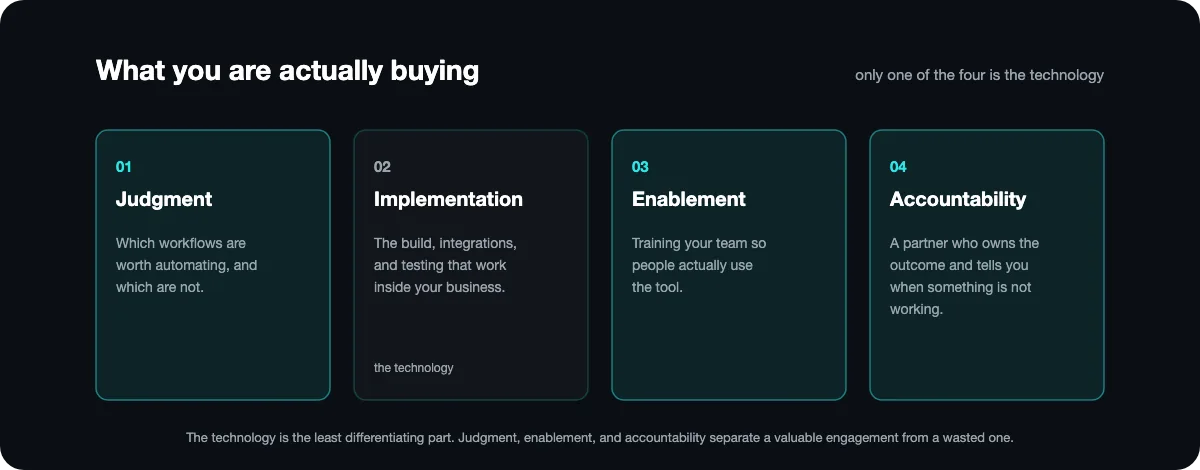
The technology is the least differentiating part. Strong models and automation platforms are available to everyone, including your competitors. What separates a valuable engagement from a wasted one is the judgment and follow-through around it.
What determines whether AI is worth it for a small business?
AI pays off when it produces a measurable change in how your business runs. Three kinds of return show up most often, and you can estimate all three yourself.
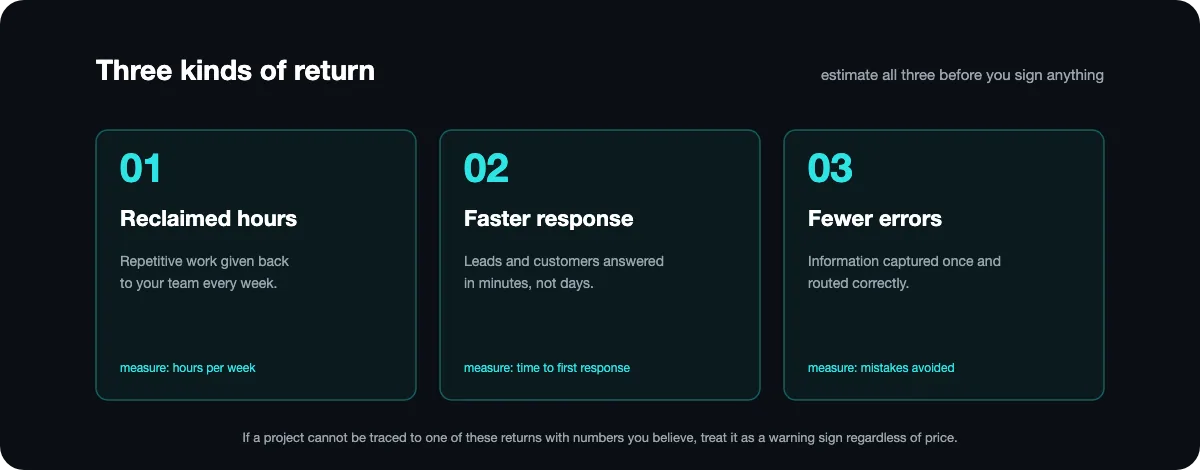
Reclaimed hours. Look at the work your team repeats: copying data between systems, drafting routine responses, scheduling, following up, reconciling records. Estimate the hours those tasks consume each week and what that time is worth.
Faster response. When a lead calls and nobody answers, or a customer email waits until tomorrow, revenue quietly leaks. Businesses that respond in minutes win work slower competitors never see.
Fewer errors. Manual data entry produces mistakes, and mistakes cost money: wrong invoices, missed appointments, duplicated orders. A system that captures information once and routes it correctly removes problems you may have accepted as normal.
If a proposed project cannot be traced to one of these returns with numbers you believe, treat it as a warning sign regardless of price.
Why is the cheapest quote rarely the cheapest outcome?
Because the total cost includes everything after launch, and the cheapest quotes usually cover only the launch. A low bid that excludes data cleanup, training, and post-launch support leaves you to absorb those costs, often with worse results.
The pattern is common: a system gets built, works in the demo, and three months later nobody uses it. The workflow reverts to spreadsheets and inbox triage. The money was spent, the problem remains, and the "affordable" project produced no return. A thorough engagement that includes adoption work often costs less per unit of value.
So compare what is included, not just totals. Two proposals at different prices are rarely offering the same thing.
What does AI ownership cost after launch?
The quote covers the build. Ownership covers everything else, and a serious proposal names these items explicitly:
- Data preparation. Your systems hold information in formats AI tools cannot use directly. Cleaning and structuring it is real work, and usually the most underestimated line in a project.
- Training. Your team needs to learn new tools and habits. Skipping it is the most common reason implementations fail.
- Adoption support. The weeks after launch determine whether the tool becomes part of how the business runs or a shortcut nobody takes. Check-ins turn a launch into lasting change.
- Ongoing support. Tools change, your business changes, and questions will come up. Know who answers them and on what terms before you sign.
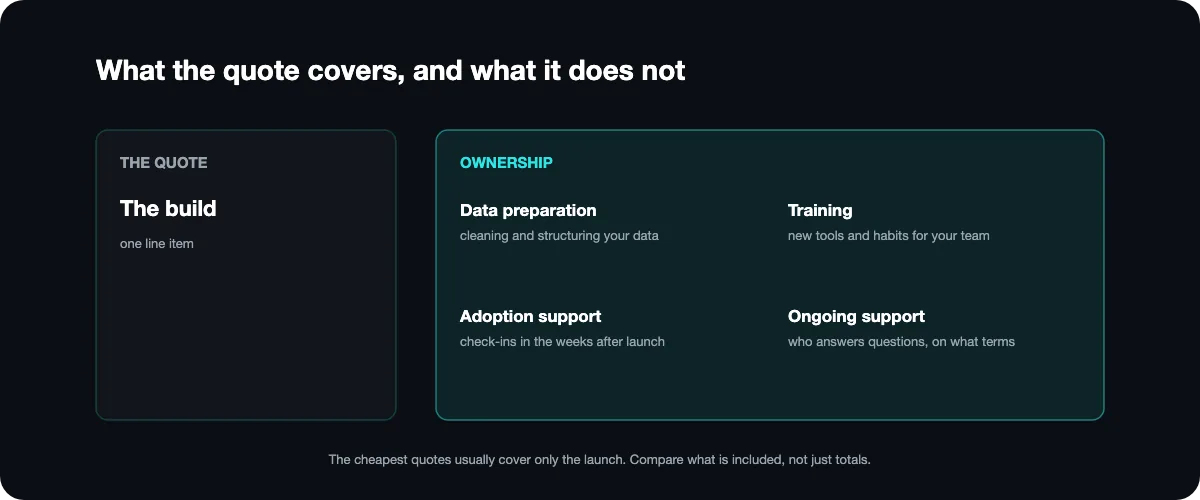
Ask every consultant how their proposal handles these four. Vague answers here signal more than any number on the bottom line.
What questions expose a weak AI proposal?
Ask these five. A strong consultant welcomes every one, and the answers tell you more than the price does.
- Which specific workflows will this change, and what measurable difference should I expect in each? Vague scope produces vague results.
- Who owns the system, the data, and the configurations when the engagement ends? You should own all of it.
- What happens in the first 90 days after launch, and who is responsible for adoption? That window is where value is won or lost.
- What do you need from my team, and how much of their time will this take? Your team's hours are part of the real cost.
- What would you advise me not to automate? A consultant who tells you where AI is the wrong answer is one you can trust where it is the right one.
If a proposal cannot answer these cleanly, the price comparison you were preparing is pointless: you are not comparing equivalent work.
How do you get a real number for your AI project?
A discovery call is how you get a number you can rely on. A consultant maps the workflows that cost you the most time, identifies good automation candidates, flags complications in your data, and outlines what the engagement would include: a figure grounded in your situation, plus an honest view of the return to expect.
That is the conversation worth having. PRESHai helps small businesses find the workflows worth automating, implement them properly, and stay accountable for adoption after launch.
Book a discovery call and get a real number, grounded in how your business actually runs.
Frequently asked questions
How much does AI consulting cost for a small business?
Cost varies with scope and complexity: the number of workflows, the condition of your data, and the training your team needs. Published ranges reflect many kinds of engagements and may not describe yours. A discovery call with a consultant who has seen your workflows is the only way to get a number you can budget against.
What is included in an AI consulting engagement?
A complete engagement includes workflow analysis, implementation and testing, data preparation, team training, adoption support, and ongoing help. A lower price often means fewer of these items, so compare contents, not totals.
Is AI consulting worth it for a small business?
It is worth it when the project produces measurable return: hours returned to your team, faster responses to customers, or fewer costly errors. Estimate those returns first. If a project cannot be traced to a return you can measure, decline it.
What should I ask an AI consultant before hiring them?
Ask which workflows will change and by how much, who owns the system and data afterward, what happens in the first 90 days, how much of your team's time the project requires, and where they would advise against automation. Clear answers predict a good outcome better than price does.
Why do AI consulting quotes vary so much?
Quotes differ because the work differs: scope, data condition, integrations, and the depth of training and support included. Two proposals with very different prices usually describe very different engagements, which is why comparing totals without contents is misleading.
How do I start with AI if I have a limited budget?
Start with one workflow that consumes significant time or causes frequent errors, implement it well, and measure the result. A focused first project builds the confidence and clean data that make later projects cheaper. A discovery call helps you pick the right first target.