

AI strategy is moving from model access to the operating layer around the work itself. For the IT channel, the opportunity is governed AI implementation: routed models, scoped agents, usable context, human review, and workflows that keep getting better.
Inside this article
- Model access is becoming infrastructure risk, not just benchmark news.
- Open weights and pricing pressure make routing part of the strategy.
- The real work is governed AI implementation: workflow redesign, context, permissions, memory, review, and owners.
AI is starting to move out of the model leaderboard and into the operating assumptions underneath work.
The topics may be different on the surface: Fable 5 access restrictions, GLM-5.2, open weights, OpenAI pricing pressure, workflow failures, agent identity, and record-and-replay automation.
But underneath all of it is the same shift.
The model is no longer the whole strategy. It is becoming one part of a larger operating layer that decides which model runs, what context it can see, what tools it can touch, what it is allowed to change, what gets reviewed, and how the system learns after the work is done.
That changes the questions businesses need to ask. They are not just going to ask which model to use. They are going to ask what happens if the model becomes unavailable, what work can fall back to another provider, what data can move, what permissions apply, and who owns the decision when an agent takes action.
Those are not abstract AI questions.
They are operating questions.
Model Access Is Becoming Infrastructure Risk
The Fable 5 story is useful because it makes one thing visible: model access is not just a product feature.
It can become a dependency.
Anthropic's June 12, 2026 statement said a U.S. government directive required it to suspend access to Fable 5 and Mythos 5 for foreign nationals, which caused the company to disable those models for customers while complying. The policy specifics will keep moving. The operational point is already here.
If a business builds support, engineering, reporting, quoting, security, or operations work around a model, access to that model starts to look like infrastructure. Availability matters. Geography matters. Vendor posture matters. Data residency matters. Fallbacks matter.
For MSPs, solution providers, distributors, and manufacturers, this is where the opportunity gets practical. Customers do not need a lecture on model drama. They need help deciding which workflows depend on which models, what breaks if access changes, and how to keep the work moving.
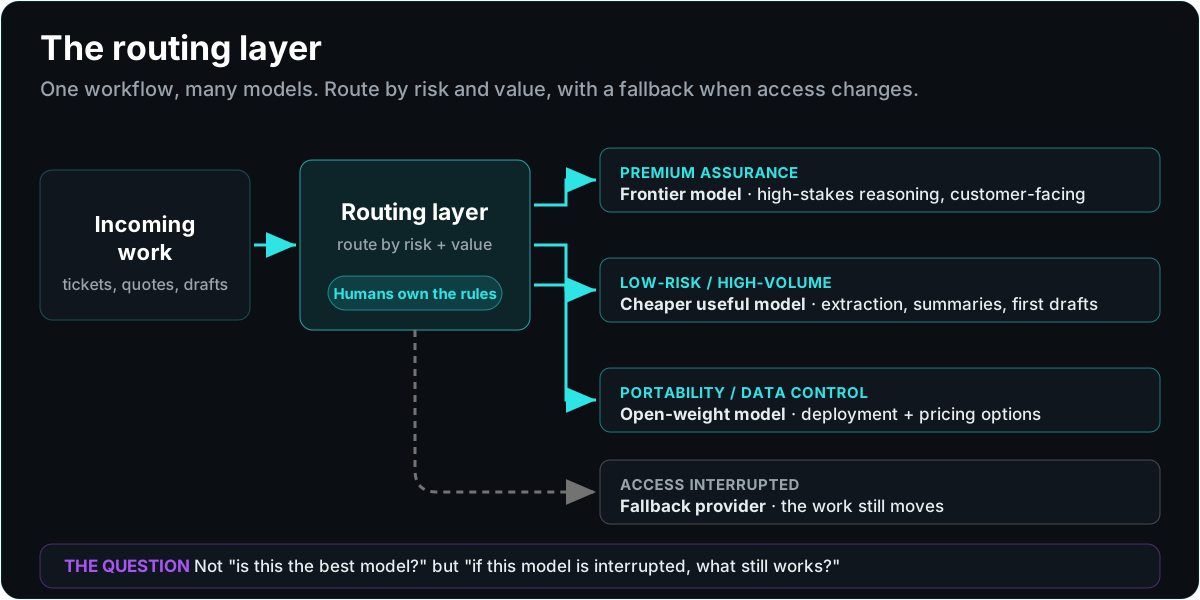
The right question is not just "is this the best model?"
It is: if this model is interrupted, what still works?
Open Weights Change the Cost Conversation
GLM-5.2 brought the open-weight conversation back into the business lane.
The important point is not that every company should rush to self-host. Most should not. Buying GPUs because one provider had a bad week is not a strategy.
The important point is routing.
Open-weight models can shift the economics even when they are not the right answer for every task. A lower-cost model does not need to beat the frontier model everywhere. It only needs to be useful enough for the right work: extraction, summaries, first drafts, internal lookup, classification, formatting, or low-risk workflow steps.
That is why the distinction between open source and open weights matters. Open weights can give enterprises and providers more deployment and pricing options, even when the full training code, data, and recipe are not available, and they are increasingly built for long-horizon tasks rather than one-off prompts.
The IT channel should treat that as a design question, not a culture war.
Which tasks need premium assurance? Which tasks need portability? Which tasks need data control? Which tasks can safely run on cheaper useful intelligence? Which tasks should not run autonomously at all?
That is the routing layer.
And increasingly, the routing layer is where strategy lives.
The Cost Problem Is a Work Problem
Once AI starts doing real work, the cost conversation gets messy.
It is easy to blame token pricing. Sometimes that is fair. But in a lot of AI deployments, the bill is a symptom of a deeper problem.
The workflow is unclear. The agent has the wrong context. The tool scope is too broad. The permissions are fuzzy. The output has no owner. The system does not remember what worked last time, so every run pays again to rediscover the same fix.
That is not just a model problem.
That is a work problem.
Put an agent on a broken process and the process does not become modern. It becomes faster at being broken.
For channel companies, this is where AI implementation has to separate itself from AI theater. AI theater buys licenses, adds a sparkle button, announces a pilot, and hopes the business changes. AI implementation maps the workflow, defines the owner, scopes the tools, writes the approval rules, measures the outcome, and improves the system after launch.
The model can help.
The work still has to be designed.
Context Changes the Permission Model
As agents get closer to the work, context becomes the real implementation challenge.
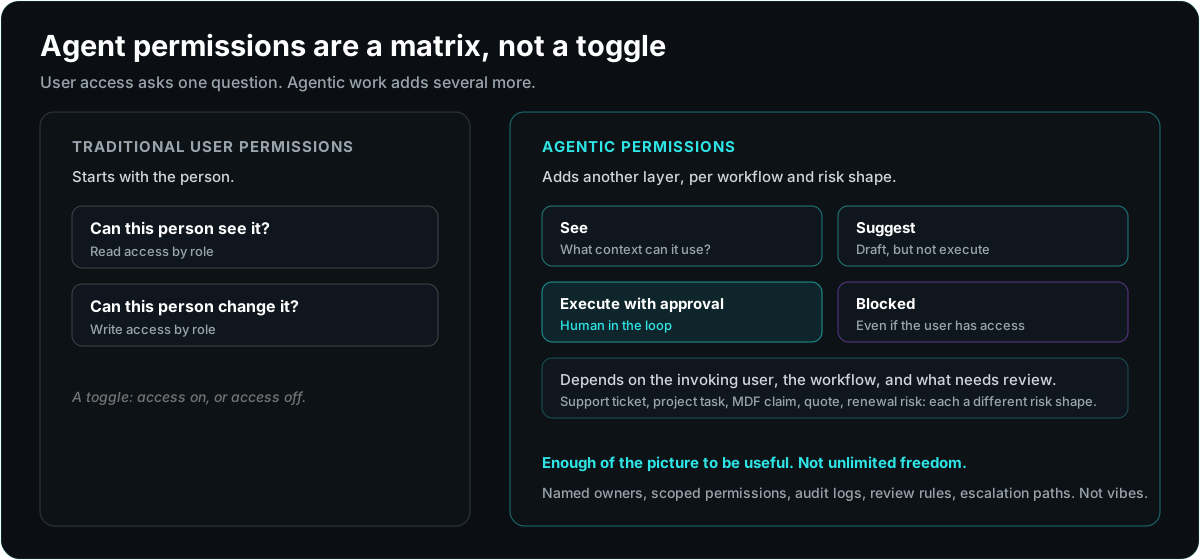
Traditional permission models usually start with the user. What can this person see? What can this person change? What systems does this role have access to?
Agentic workflows add another layer.
What can the agent see? What can it change? What can it suggest but not execute? What context can it use from the company knowledge layer? What depends on the invoking user? What needs approval? What should be blocked even if the user has access?
That is not a toggle.
It is a matrix.
This matters for the IT channel because every workflow has a different risk shape. A support ticket, project task, MDF claim, quote, partner enablement motion, renewal risk, and customer escalation all need different context and different controls.
Agents need enough of the picture to be useful. They do not need unlimited freedom. The failure modes here are now well documented enough to design against, from prompt injection to excessive agency, as catalogued in the OWASP Top 10 for Agentic Applications.
That means channel organizations need to design shared intelligence layers carefully: CRM records, PSA tickets, RMM alerts, ITSM history, documentation, email, chat, project notes, call summaries, customer wins, and operating procedures. The goal is not to expose everything. The goal is to make approved context usable at the moment work happens.
That is an implementation problem.
It needs named owners, scoped permissions, audit logs, review rules, and escalation paths.
Not vibes.
Automation Is Moving to Where the Work Happens
Record-and-replay automation makes the next phase easier to understand.
The barrier used to be knowing how to code the workflow. Increasingly, the barrier is knowing how to do the work clearly once.
OpenAI's Codex Record & Replay documentation describes a workflow where a user demonstrates a task on a Mac and Codex turns that pattern into a reusable skill. That is important because many valuable business processes live in portals, spreadsheets, ticketing systems, browser tabs, desktop software, and legacy tools that never justified a custom integration project.
If operators can capture the work where it already happens, more automation becomes possible.
But governance has to travel with the work.
Recording a process does not make it safe. Replaying a process does not make it correct. If the inputs are messy, the permissions are wrong, or the exception path is unclear, automation spreads the problem faster.
For IT businesses, this is the service opportunity. Help customers identify the right workflows, clean up the steps, standardize the inputs, define the owners, set the controls, and decide what gets reviewed before anything repeats at scale.
The win is not automation for its own sake.
The win is governed work.
The Work Ahead
Taken together, these points bring us back to a critical divide.
There is AI theater, and there is AI implementation.
AI theater chases the newest model, reacts to the newest pricing rumor, records a workflow, and hopes the organization changes.
AI implementation builds the harness around the work.
That means routing models by risk and value, creating fallback plans, connecting the systems where work already happens, designing the company context layer, defining what agents can read and change, building review into the workflow against an established control framework like the NIST AI Risk Management Framework, and measuring whether the work actually got better.
It also means training teams around new operating patterns, not just new tools. A recorded workflow still needs a process owner. A cheaper model still needs a routing rule. A company brain still needs access control. An agent still needs review when risk, trust, money, customers, or compliance are involved.
The companies that win this next phase will not be the ones with the longest list of AI tools.
They will be the ones that make the work better.
That is the harness.
And that is where AI starts to matter.
Watch the full Model Behavior episode for the deeper discussion on Fable 5, GLM-5.2, and record-and-replay automation.