
Inside this article
- A monthly governance review checks that AI is doing useful work within the limits you set, and decides what changes.
- A good agenda runs evidence first, controls in the middle and decisions last. The monthly report supplies most of the evidence.
- The meeting is judged by what it decides: the next improvement, any change to controls, and an owner for each open issue.
Governance can sound heavier than it is. For most companies in the IT channel, it comes down to a regular meeting where the right people look at what AI did last month and agree what happens next.
This article gives you an agenda for that meeting. It is guidance you can adapt, built around the monthly report and review in PRESHai's Managed AI service. It works for a small team with one workflow and scales up for a larger business with more at stake.
What is a monthly AI governance review for?
It answers two questions. Is AI doing useful work? Is it doing that work within the limits we set?
The first question is about value: adoption, results and what to improve. The second is about control: who and what can access information, which actions are allowed, where a person must approve, and how activity is recorded. Many teams hold separate meetings for the two. One meeting works better, because the same evidence serves both, and a decision about value often changes a control.
The review is also a decision meeting. Status can be read in advance. The time in the room is for the choices only that group can make.
Who should be in the room?
The people who can decide, and no more. As guidance, four roles cover it:
- The owner who sets priorities. One named person who makes the final call on what gets worked on next.
- A process owner for each team involved. They know whether a workflow is helping the people who use it.
- Whoever is responsible for security. In a small company this may be the IT lead or the owner. They speak for access and approvals.
- The contact who runs the service. The person who knows the setup and brings the evidence. Under Managed AI, you have a dedicated contact who knows your setup.
In a small business, two or three people may hold all four roles between them. That is fine. What matters is that each role is represented by someone, and that everyone knows who is wearing which hat.
What should be on the agenda?
Here is a suggested order. It moves from evidence to controls to decisions, so the choices at the end rest on what was reviewed at the start.
- Usage and adoption. Who is using AI, how often and for what work.
- Results. Each workflow against the measure agreed for it.
- Exceptions and issues. What went wrong, what was done about it and what is still open.
- Controls. Access, approvals and what AI may do. Review any change since last month and any change requested.
- AI usage and cost. How much AI was used and where the spend went.
- Platform changes. What is new in the tools and what it means for your setup.
- Next priority. The one improvement to work on next, and the measure for it.
- Decisions and owners. Read back what was decided and who owns each item.
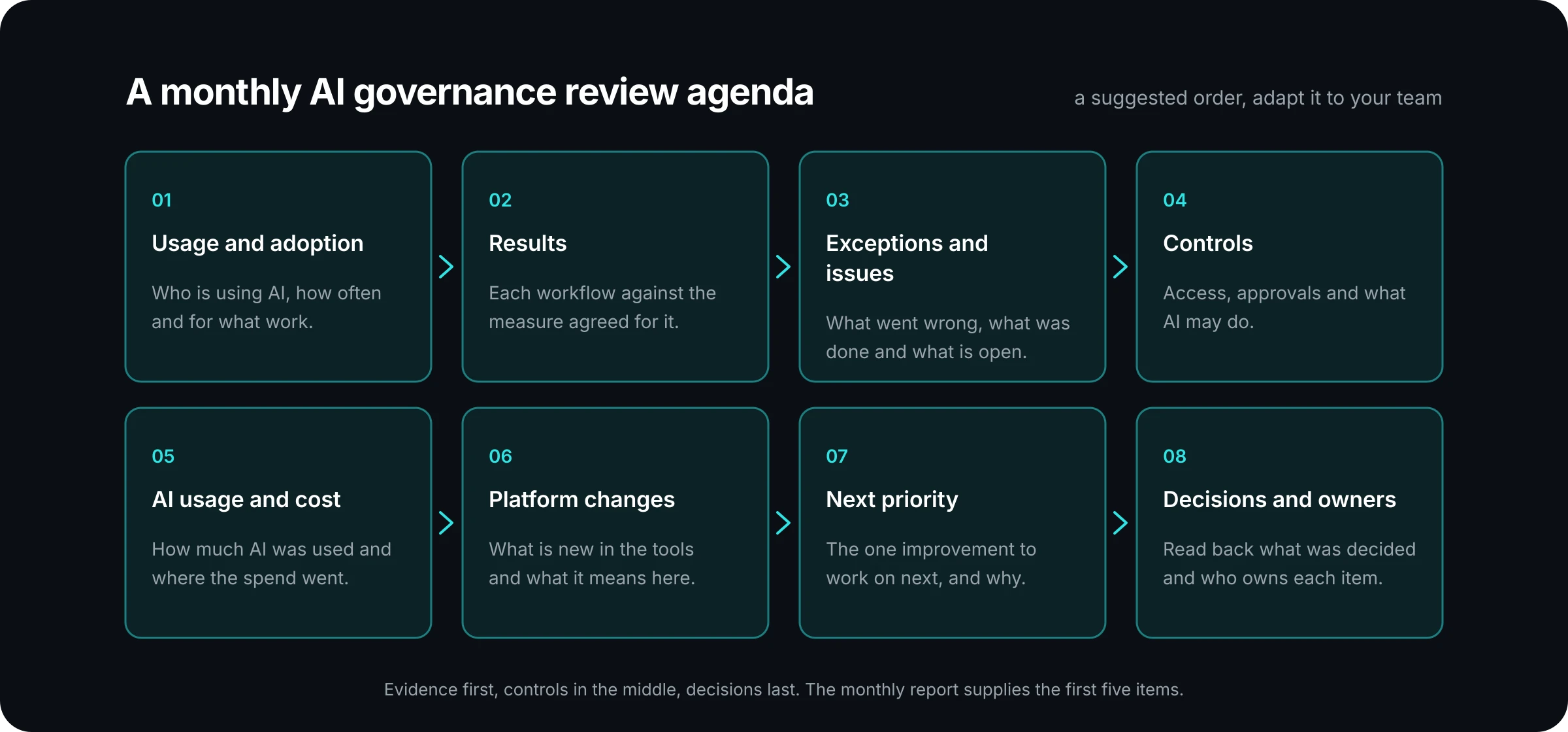
Do not give the items equal time. If the report went out in advance, the first three can be covered by exception: only what moved, and only what needs discussion. Spend the saved time on controls and the next priority.
What evidence should you bring?
The monthly report, sent ahead. In Managed AI, the report is the agenda for the monthly review. It covers usage and adoption, results, what changed, exceptions and issues, AI usage and next priorities, which lines up with the first half of the agenda above. The reporting and briefings page describes what arrives each month.
Add three short lists to it:
- Changes to roles, access and approvals since the last review, including new users, new connections and any permission that was widened.
- Open issues, each with an owner and the date it was raised.
- Platform and vendor changes that touch a workflow you depend on.
How easy this is to gather depends on your platform. On PRESHos, what an agent wants to change waits at one gate, where a person sees exactly what will change and then approves or rejects it, and there is a record of who did it, which agent, which tools and what changed. The governance page shows how that works. On other platforms, find out which admin reports hold the same information before the first review, so nobody is searching for it during the meeting.
What decisions should come out of it?
A short written list. As guidance, a healthy review ends with four kinds of decision:
- The next improvement and its measure. One bounded change, with the result you expect to see.
- Control changes, approved or declined. Any change to who can access what, or to what AI may do, is decided here and recorded.
- An owner for each open issue. No issue leaves the room unassigned.
- Anything to raise with leadership. A risk, a cost trend or a result worth sharing.
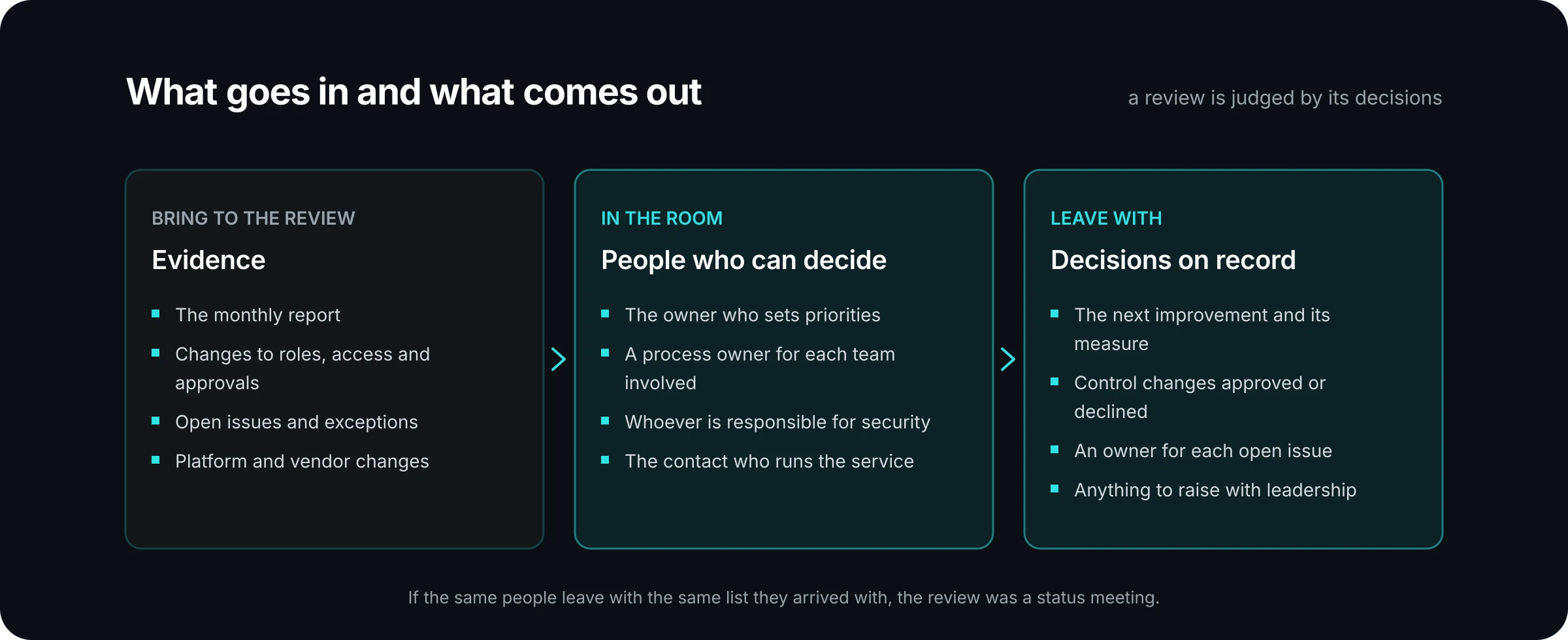
Keep the decision list from every review in one place. After a few months it becomes the most useful governance document you have. It shows what was decided, when, by whom and on what evidence, which is what an auditor, a customer or a new executive will ask to see.
How does the review change with company size?
The agenda holds. The formality around it grows. PRESHai's Managed AI plans show the pattern.
For a small business, the plan includes a monthly brief and review. This is one conversation that covers the whole agenda, often with the owner and one or two managers.
For a midmarket company, the plan includes a monthly service and governance review. AI is now running workflows the team depends on, so it makes sense for the review to look harder at how the service is running and how connected systems are changing.
For an enterprise, the service includes a monthly steering committee and a quarterly review against agreed KPIs. More functions are involved, so the monthly meeting sets direction across them, and the quarterly review holds the program to measures chosen in advance.
The plans page shows the three side by side. If you are setting up a review yourself, pick the level of formality that matches how many people must agree to a change.
What makes a governance review go wrong?
Three habits, all easy to fix.
It turns into a status meeting. Someone walks through the report page by page and time runs out before any decision. Send the report ahead and start with questions.
Controls are treated as settled. Access was set up at the start and nobody has looked since. Put item four on every agenda, even when the answer is that nothing changed.
Decisions are not written down. People leave with different memories of what was agreed. Reading the list back at the end takes two minutes and prevents most of this.
Where to go from here
Put the first review in the calendar before you perfect the agenda. Use the eight items above, send whatever report you have in advance, and write down what was decided. The second meeting will be better than the first because you will know which evidence was missing.
If you want the report, the review and the follow-through handled for you, they are part of Managed AI. The Managed AI page explains what we run and how the month works.
Talk to us about what is live today, and we will talk through what a monthly review should cover for your team.