
Inside this article
- The platform choice should follow the work, the systems involved and the controls your team needs. Each of the three platforms fits a different priority.
- For the team that runs it, the platform changes where sign-on, connections, approvals and usage evidence live. The duties themselves stay the same.
- A short set of questions, answered before you commit, tells you more than any feature comparison.
Most platform comparisons are written for the person choosing. This one is written for the people who have to run the platform afterwards: the operations lead, the IT manager, the person who gets the message when something stops working.
PRESHai sets up and manages AI for customers on ChatGPT, Claude or PRESHos. That gives us a practical view of the question. The platform matters, and it matters most to the team that administers it.
How do the three platforms differ in what they are for?
Start with what each one is the right answer to. These are the reasons we give on our supported platforms page:
- PRESHos. Choose it when AI needs to move work across several business systems, with custom permissions, approval steps and a clear record of what happened.
- ChatGPT. Choose it when the priority is a broad employee workspace for writing, research, analysis, coding and approved connections to company tools.
- Claude. Choose it when the priority is document-heavy work, large amounts of context, coding and enterprise access controls.
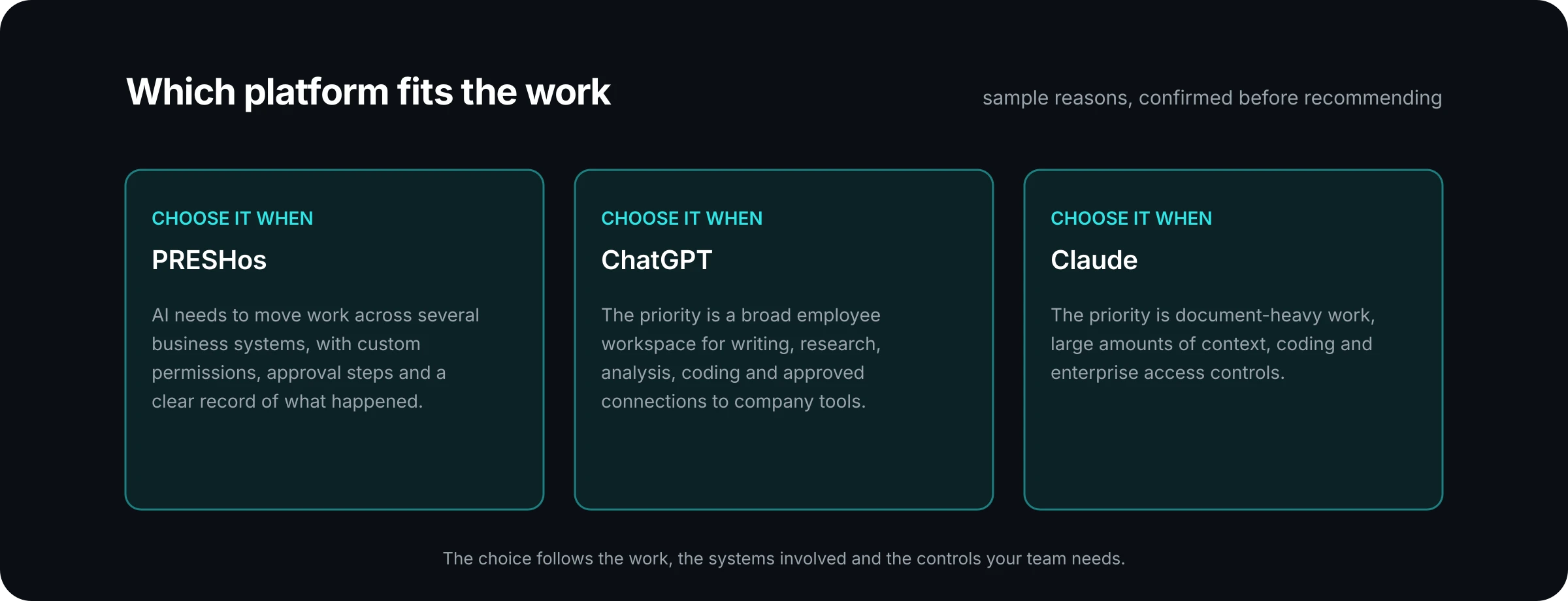
Treat these as sample reasons. Features change and vary by plan, so we confirm the current fit before recommending a platform. You should expect the same of anyone who advises you.
What stays the same whichever platform you choose?
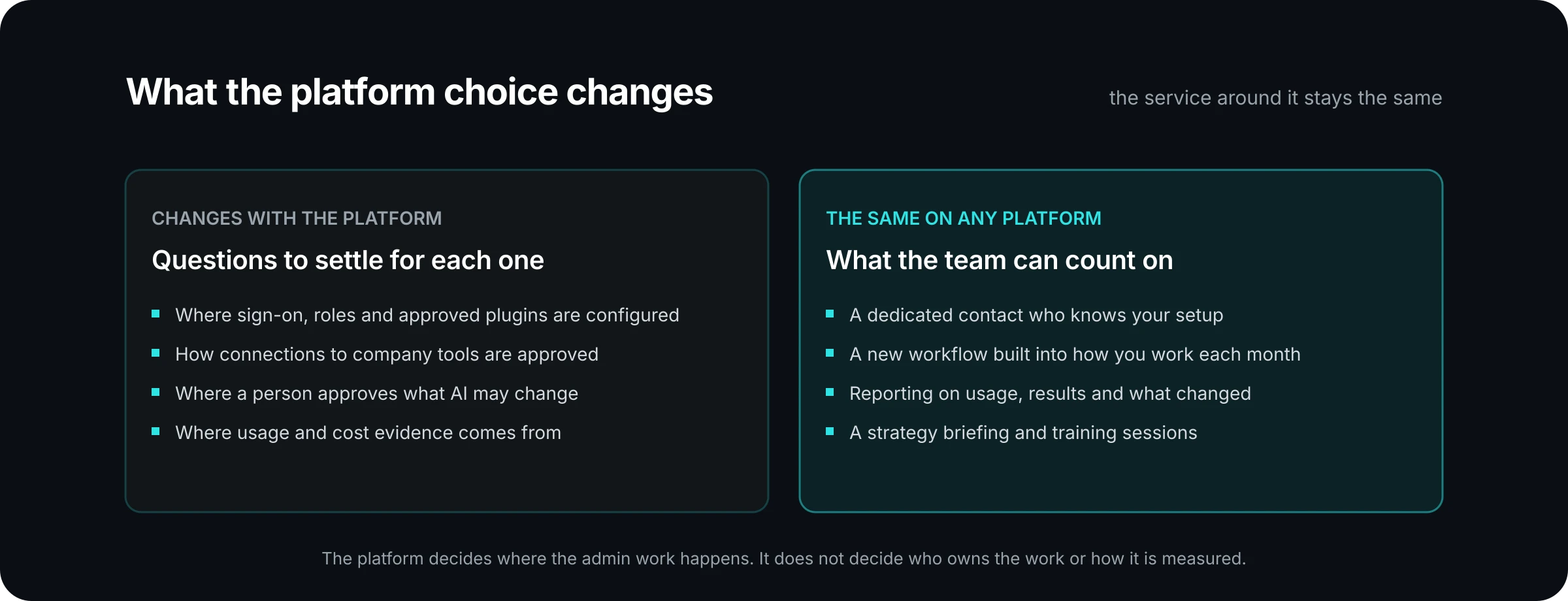
More than most teams expect. Under Managed AI, the same things are in place from day one on any of the three: the platform is set up, directory sign-on, roles and approved plugins are configured, connectors and skills are tied to your business context, and you have a dedicated contact who knows your setup.
The monthly rhythm is also the same. A new workflow is built into how you work. You get reporting on usage, results and what changed. You get a strategy briefing on what is new and what to do next. Your people get training sessions that keep them current.
So the platform choice does not decide whether someone owns adoption, controls and reporting. That is a decision about how you run AI, and it applies everywhere.
What changes for the people who administer it?
The duties stay constant and their location moves. Whichever platform you choose, someone has to answer four questions, and the answers sit in different places on each one.
- Where are sign-on, roles and approved plugins configured? Someone needs to know which screen controls who can use what, and who is allowed to change it.
- How are connections to company tools approved? Every connection to a business system is a decision about data. Know who makes it and where it is recorded.
- Where does a person approve what AI may change? If AI can take an action in a business system, find the point where a person says yes or no.
- Where does usage and cost evidence come from? You will be asked what AI is being used for and what it costs. Know which report answers that before the question arrives.
For PRESHos we can answer these directly, because it is our platform. Roles apply to people and to agents. What an agent wants to change waits at one gate, where a person sees exactly what will change and then approves or rejects it. Every run is recorded with its cost. The governance page shows how that works.
For ChatGPT and Claude, the answers depend on your plan and on how the workspace is configured, and both change over time. That is the reason to ask the four questions at setup and write the answers down, instead of assuming them from a comparison table.
What changes for the people who use it every day?
The starting point of the work. This follows from what each platform is chosen for.
When the priority is a broad employee workspace, the work usually starts with a person. Someone opens the workspace, brings a task, and gets help with writing, research or analysis. Adoption depends on habits, so training and good examples do most of the lifting.
When the priority is moving work across several business systems, the work often starts with an event: a ticket arrives, an order changes, a record is updated. People meet AI at the approval step, where they check what is about to change. Adoption there depends on trust in the controls and on clear ownership of each workflow.
Neither pattern is better. They ask different things of your team, and the training plan should match the one you have chosen.
How should you choose a platform?
Start with the work. We recommend the platform that fits your work, systems, security needs and budget. As guidance, three questions sort most cases:
- What is the first piece of work you want AI to take on? A drafting and research task points one way. A process that crosses three systems points another.
- Which systems does that work touch? List them. The list tells you how much connection and permission work is ahead.
- Who must approve what, and what record do you need afterwards? Your answer sets the bar for controls.
Two examples show how the answers lead to different places. A solution provider whose sales team wants help drafting proposals and researching accounts has a workspace problem. A distributor that wants partner enquiries triaged, checked against order data and routed for approval has a cross-system problem. Both are reasonable first projects, and they would not start on the same platform for the same reasons.
What if the right answer changes later?
It can. Providers and models change, and so does your business. Part of the monthly service is practical advice as OpenAI, Anthropic, open-source and other options change, so the question gets revisited with evidence instead of by rumour.
You can make a later change easier from the first day. Keep a plain description of each workflow: what triggers it, which systems it touches, who approves it and how it is measured. A workflow that is documented in those terms can be rebuilt elsewhere. One that lives only in a tool's settings cannot. Our article on why an AI strategy needs an exit plan covers this in more depth.
Where to go from here
If you are the person who will run the platform, ask to be in the selection conversation. Bring the four admin questions and the three choosing questions. A platform chosen with the operating team in the room is easier to live with than one handed over afterwards.
The scope of what we set up and manage is on the what we run page, and the way the service changes with company size is on the plans page.
Talk to us about which AI tools your team already uses, and we will talk through what fits the work and what we would manage.