
Inside this article
- Managed AI is one service with the same foundations at every size: setup from day one, then a new workflow, reporting, a briefing and training every month.
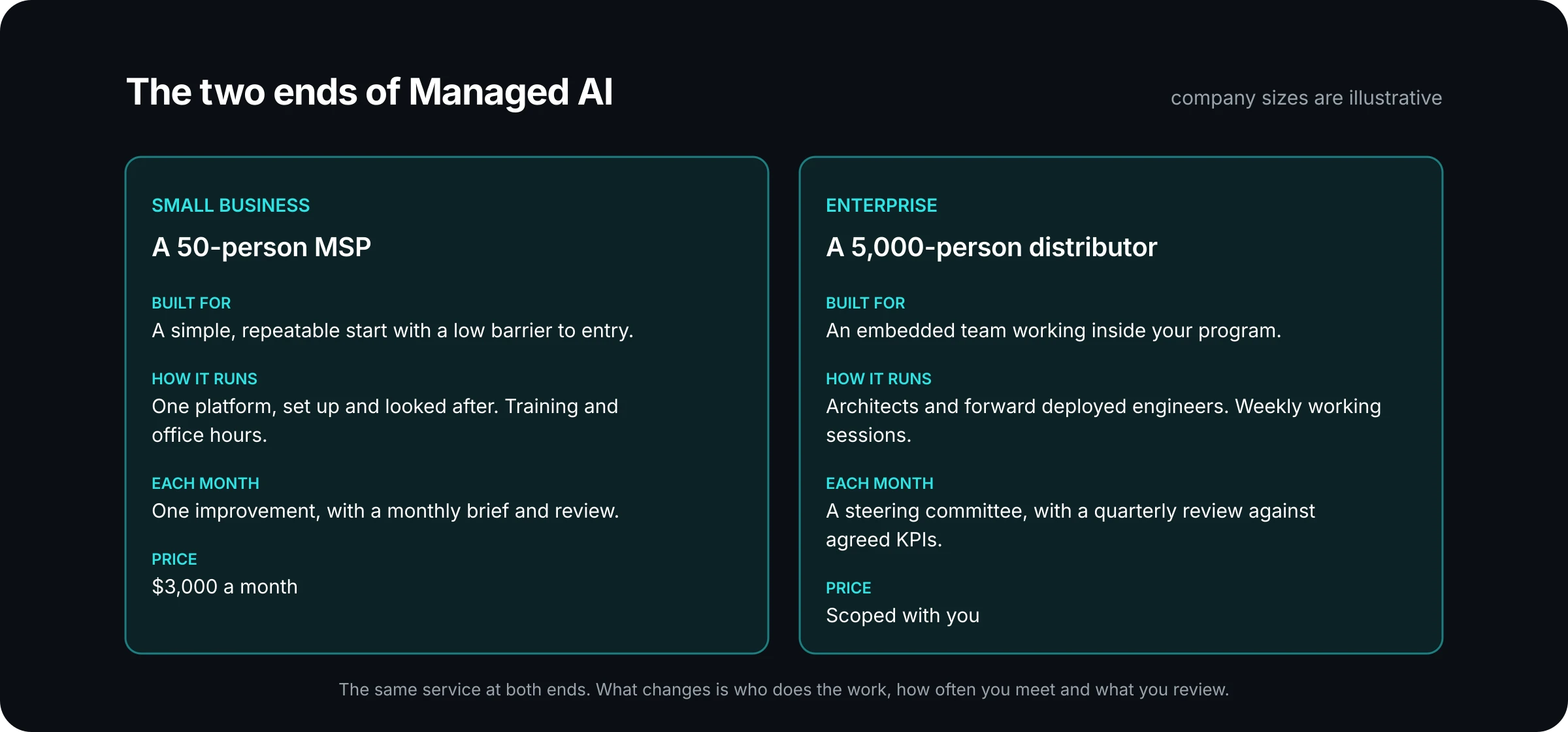
- At the small end it is one platform looked after, one improvement a month, a monthly brief and review, and training with office hours, at $3,000 a month.
- At the enterprise end it is an embedded team of architects and forward deployed engineers, weekly working sessions, a monthly steering committee and a quarterly review against agreed KPIs, scoped with you.
A 50-person managed service provider and a 5,000-person distributor both want the same thing from AI: useful work done, under control, with someone accountable for keeping it that way. They do not need the same service to get there.
This article compares the two ends of PRESHai's Managed AI service. The company sizes in the title are illustrations, chosen to make the contrast easy to see. Our plans are described by size of business, with small business at one end and enterprise at the other, and your own company may sit anywhere between.
What is the same at both ends?
The foundations. Whatever the size of the business, Managed AI puts the same things in place from day one: platform setup on ChatGPT, Claude or PRESHos, directory sign-on with roles and approved plugins, connectors and skills tied to your business context, and a dedicated contact who knows your setup.
The monthly content is also shared. A new workflow is built into how you work. You receive reporting on usage, results and what changed. You get a strategy briefing on what is new and what to do next. Your people get training sessions that keep them current.
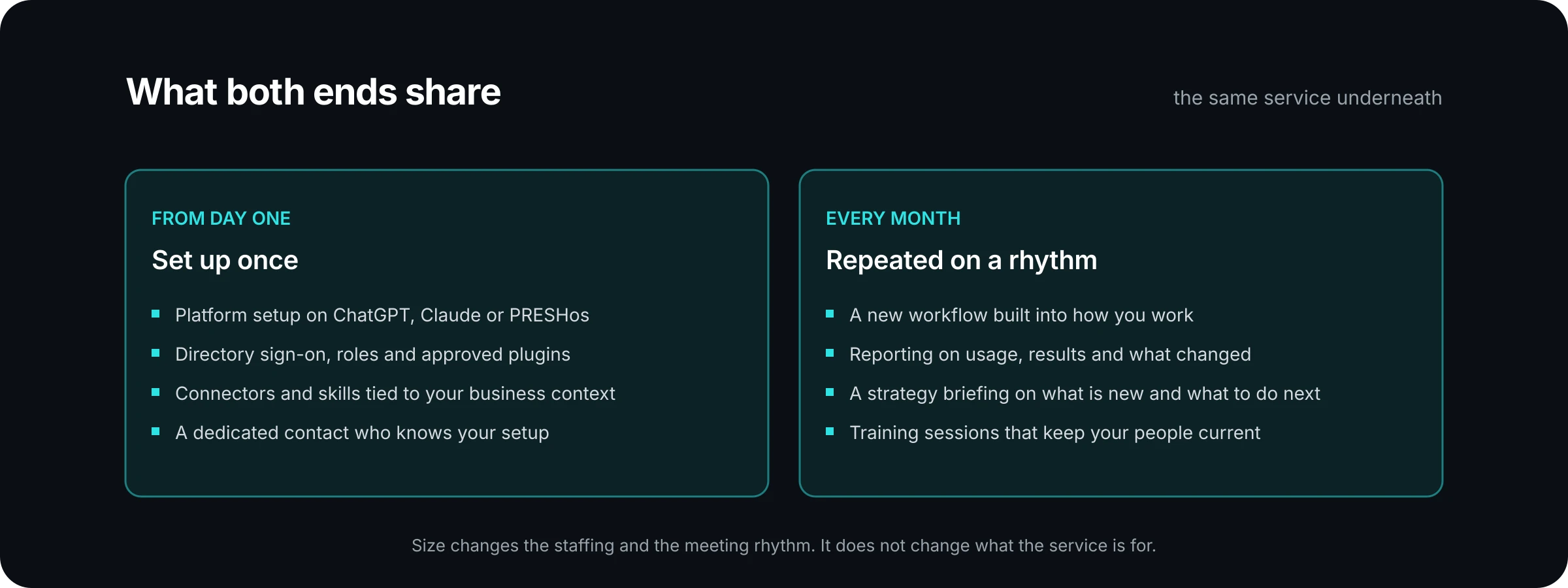
The what we run page sets out this scope in full. What differs by size is who does the work, how often you meet, and what gets reviewed.
What does Managed AI look like for a small MSP?
The small business plan is built as a simple, repeatable start with a low barrier to entry. It has four parts:
- One platform, set up and looked after. You are not asked to run several tools at once.
- One improvement each month. A single bounded change, chosen with you and released into real work.
- A monthly brief and review. What happened, what is new and what to do next.
- Training and office hours. Sessions for your people and a place to bring questions.
The price is $3,000 a month.
Picture how that fits a small MSP. As an example, the owner and the service manager are the same two people who would otherwise have to evaluate tools, set up access and train the team, on top of running the business. They do not have a spare person to own AI. The plan gives them one platform, one contact and one decision a month: what to improve next.
An example first workflow might be a ticket summary for technicians, or a draft of the monthly client report. The following months might take on the next task the team raises. None of these examples is a large project, and that is by design. A small team absorbs one change at a time far better than a programme of ten.
What does Managed AI look like for a large distributor?
The enterprise service is described differently because the situation is different. It is an embedded team working inside your program:
- Architects and forward deployed engineers. Senior technical people who work inside your program.
- Weekly working sessions. A weekly rhythm for the work itself.
- A monthly steering committee. A regular point for leaders to review progress and set direction.
- A quarterly review against agreed KPIs. The program is held to measures chosen in advance.
Enterprise services are scoped with you before they are priced.
Picture a large distributor, again as an example. AI touches several functions at once: partner operations, sales, finance, marketing. Each has its own systems, its own data owners and its own view of risk. A single monthly improvement would be too slow, and a single monthly meeting would not reach the people who need to agree. The work needs engineers who can sit inside the program and a governance structure that matches the company's own.
Why does the rhythm change with size?
Three things grow as a company grows, and each one pushes the service in a clear direction. This is our reasoning, offered as a way to think about your own case.
The number of people who must agree. In a small MSP, the person who sets the priority is often the person who approves the result. In a large distributor, a change can involve a process owner, a data owner, security and a budget holder. A steering committee exists to get those people to a decision in one meeting.
The number of systems the work touches. One platform and a few connections can be looked after by a small team. Work that crosses many business systems needs architects who understand how they fit together.
The cost of getting it wrong. A larger business usually has more at stake in each workflow, so it asks for more formal measurement. A quarterly review against agreed KPIs answers that need. A small team gets what it needs from a monthly brief.
The cadence follows from these pressures. A weekly session is right when a week's delay is expensive, and a monthly review is right when it is not.
What about companies in between?
Many readers will be neither of these. The midmarket service sits between the two and is built for the workflows your team now depends on. It includes monitoring and run triage, a planned change bundle each month, connector watch as vendors change, and a monthly service and governance review. Like the enterprise service, it is scoped with you.
The shift from small business to midmarket is a shift in emphasis. At the small end the question is how to get started. In the middle, AI is already doing work people rely on, so the question becomes how to keep it running as systems and vendors change.
How do you tell which end you are closer to?
Headcount is a rough guide and often a misleading one. A 200-person company with one simple workflow may need less than a 60-person company whose service delivery already runs through AI. These questions, offered as guidance, sort it better:
- How many workflows does your team depend on today? None or one suggests a simple start. Several suggests operations.
- How many business systems does the work cross? More systems means more connection and permission work.
- How many people must approve a change? If the answer is one or two, a monthly review will do. If it is a room full, you need a committee.
- How formal does measurement need to be? A plain monthly report suits most teams. Agreed KPIs suit a program that reports to a board.
Bring the answers to the first conversation. They make the scoping faster and more accurate than a headcount figure.
Where to go from here
The useful comparison is with what your team can absorb, more than with a company of similar size. A service that asks for a weekly session from a team with no time will stall. A monthly brief for a program spread across five functions will not keep up.
The plans page shows the three plans side by side, and the pricing page shows what is published and what is scoped.
Talk to us about the size of your team and what is live today, and we will point you to the right plan or scope it with you.