
Inside this article
- An AI build needs two teams: an implementation team that brings the method and the engineering, and your team, which brings the work and the authority.
- From your side, three kinds of people matter most: the workflow owner, the owners of the systems involved, and the people who do the work every day.
- In each phase there is one decision that stays with you. Knowing those decisions in advance is the simplest way to keep a build moving.
Before an AI build starts, the questions from leadership are rarely about models. They are about people. Who do we need to free up? What will the supplier do, and what will they expect from us? Who signs off? Who is left holding it at the end?
Clear answers at the start prevent many of the delays that show up later. This article sets out the roles on both sides, what each does in each phase, and which decisions belong to you. It follows the way PRESHai runs an implementation, but the split applies to any build.
Who is on the implementation side?
A build needs three kinds of skill, whether they sit in three people or more.
Business specialists know how channel businesses run. They map the work with your team and speak for the people who will use the result. Their knowledge is of process, service delivery and commercial pressure.
Solution architects design how agents, systems and approvals fit together, and what can be audited.
Forward deployed engineers build the integrations and agents inside your environment, lead working sessions with your team and train the people who take the work over. The forward deployed engineering page covers this role in more detail.
At PRESHai, one team carries the work from identifying the opportunity through process design, implementation, team adoption and ongoing operation. That continuity matters. The people who heard how the work is done are the people who build for it.
Who is needed from your side?
Fewer people than most leaders expect, but the right ones.
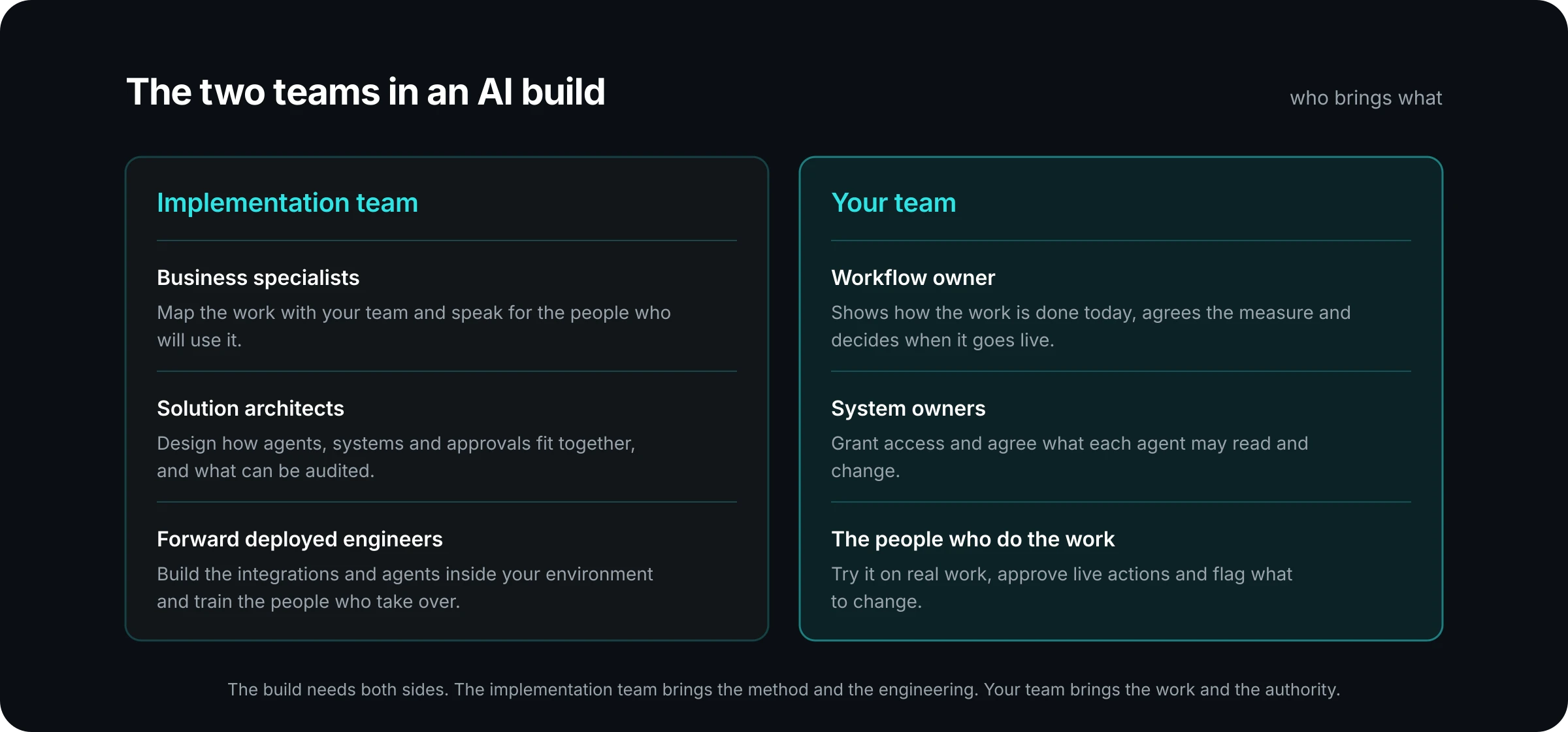
The workflow owner. One person who answers for the work being changed, such as the service desk manager or the sales operations lead. They show how it is done today, agree the measure and decide when the workflow goes live.
System owners. The people who administer the systems the work runs through, such as the PSA, the CRM, the ITSM tool and identity. They grant access and take part in deciding what each agent may read and change.
The people who do the work. A few of the technicians, coordinators or reps who handle this work every day. They try the workflow on real cases, approve live actions and say what needs to change.
A sponsor helps too, mostly to settle priorities when two teams want different things. But a build can run well with a busy sponsor. It cannot run without a workflow owner.
What does each side do in each phase?
PRESHai runs every implementation through five phases: Map, Connect, Deploy, Operate and Transfer.
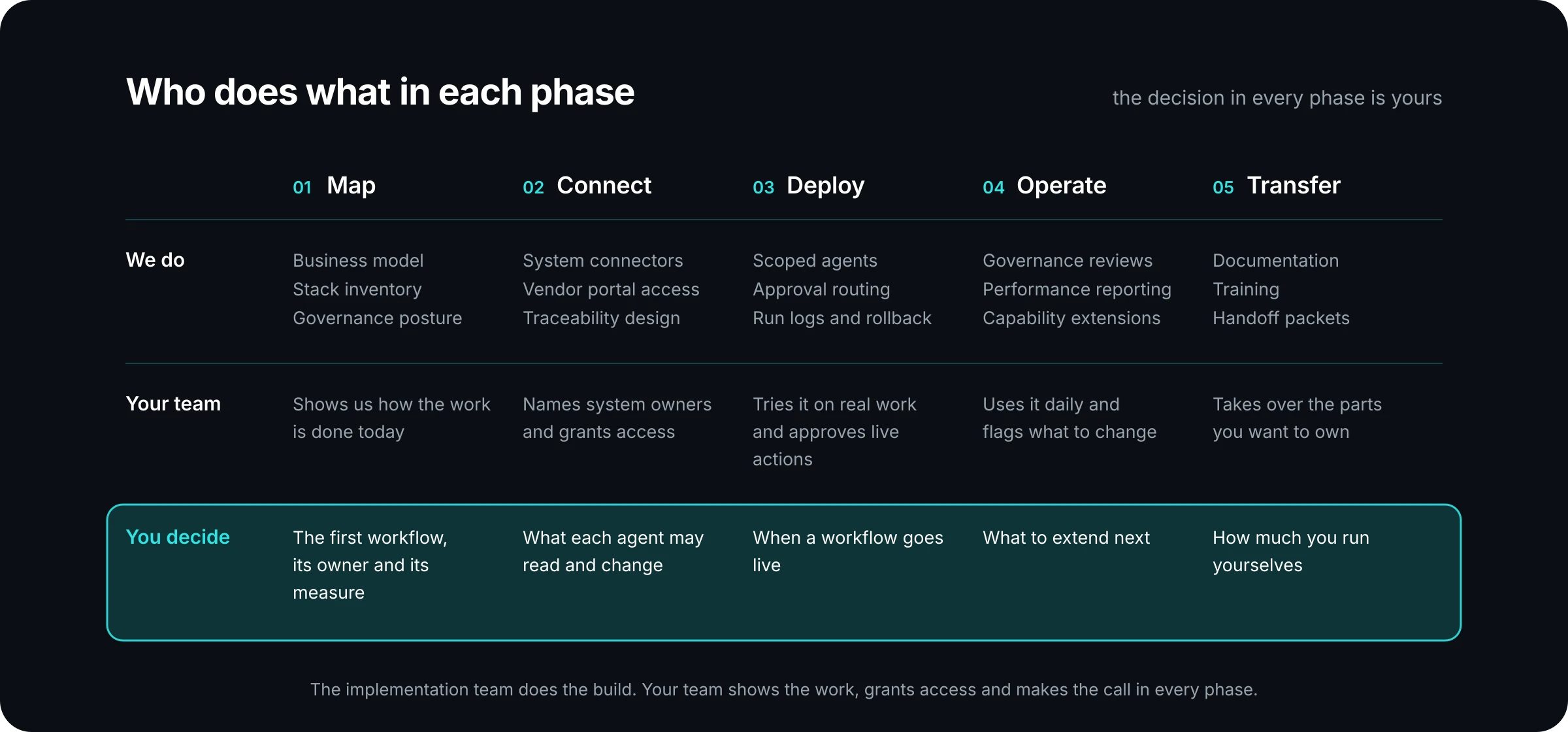
Map. We look at the business model, take an inventory of the stack and review the governance posture. Your team shows us how the work is done today. You receive a sequenced roadmap.
Connect. We set up system connectors, arrange vendor portal access and design traceability. Your team names system owners and grants access. You receive integrations that survive the pilot.
Deploy. We build scoped agents, approval routing, run logs and rollback. Your team tries it on real work and approves live actions. You receive production-grade workflows.
Operate. We run governance reviews, report on performance and extend the capability. Your team uses it daily and flags what to change. You receive a capability your team relies on.
Transfer. We provide documentation, training and handoff packets. Your team takes over the parts you want to own. You receive a team that can extend it.
The full table is on the how we work page.
Which decisions stay with you?
One in each phase, and nothing moves on until you have made it.
- In Map: the first workflow, its owner and its measure.
- In Connect: what each agent may read and change.
- In Deploy: when a workflow goes live.
- In Operate: what to extend next.
- In Transfer: how much you run yourselves.
These five are worth putting in front of your leadership team before the build starts. Each one needs a named person with the authority to decide. If the Connect decision needs security and the PSA administrator in the same room, book that early.
How much of your team's time does it take?
There is no honest single figure. Timing depends on the workflow, the integrations and access.
What can be said is where the effort falls. It is heaviest for the workflow owner in Map, when they are showing how the work is really done. It is heaviest for system owners in Connect, when access is being granted. And it is heaviest for the people who do the work in Deploy, when they are trying the workflow on real cases.
Outside those points, your team's job is to be available for questions and to make decisions promptly. The most useful thing a leader can do is protect those blocks of time.
What happens when a role is missing?
The build slows at a predictable point.
With no workflow owner, nobody can say whether the output is good enough, so go-live has no date. With no named system owner, access requests wait in a queue. With nobody from the front line involved, the workflow is built to the documented process and meets the real one on its first day.
None of these is a technical problem, and none is fixed by more engineering. Each is fixed by a name against a role before work begins. This is why every PRESHai engagement names the workflow, the system of record, the measure, the governance and the handoff up front.
Who runs it afterwards?
That is your decision, and it is better made at the start than at the end.
Some teams take over everything. Others take the daily use and leave the upkeep. In the Transfer phase we train your team and hand over what you want to own. For the rest, Managed AI is an ongoing service that keeps the implementation running and improving, with a new workflow, reporting, a strategy briefing and training every month.
Where to start
Write three names on a page: the workflow owner, the owner of the main system involved, and one person who does the work every day. Add the five decisions and who will make each one.
If you can fill that page, you are ready to scope a build. Tell us the workflow you want off your team's plate, and we will talk through who should own it, how to measure it and what is practical to build.