
Inside this article
- The first AI workflow should be one piece of repeated work, with a named owner and a number your team already counts.
- Good candidates run through systems you can reach, and keep a person approving anything that goes to a client or changes a commercial record.
- Agreeing the workflow, the owner and the measure before a build is scoped is what lets you say later whether it worked.
Most channel businesses have plenty of AI ideas. The service desk wants ticket triage. Sales wants faster quotes. Finance wants cleaner renewals. Leadership wants all of it this quarter.
The hard part is choosing what goes first. Pick something too large and it never finishes. Pick something nobody cares about and nobody notices when it works. This article gives a practical way to choose, written for operations, service and IT leaders at MSPs, solution providers, distributors and manufacturers.
Why does the first workflow matter so much?
The first workflow does two jobs. It delivers its own result, and it lays the ground for everything after it.
To get one workflow running, someone has to connect agents to the systems the work runs through, agree what those agents may read and change, and set up a record of what they did. Once that exists, the second workflow starts from a better place. The connections, the rules and the record are already there.
The first workflow is also how your organisation decides whether it trusts this way of working. A service manager who has approved an agent's work for a month, and seen the record behind it, will have a clear opinion about what should come next. That opinion is worth more than any workshop.
What makes a workflow a good first candidate?
Four checks do most of the sorting.
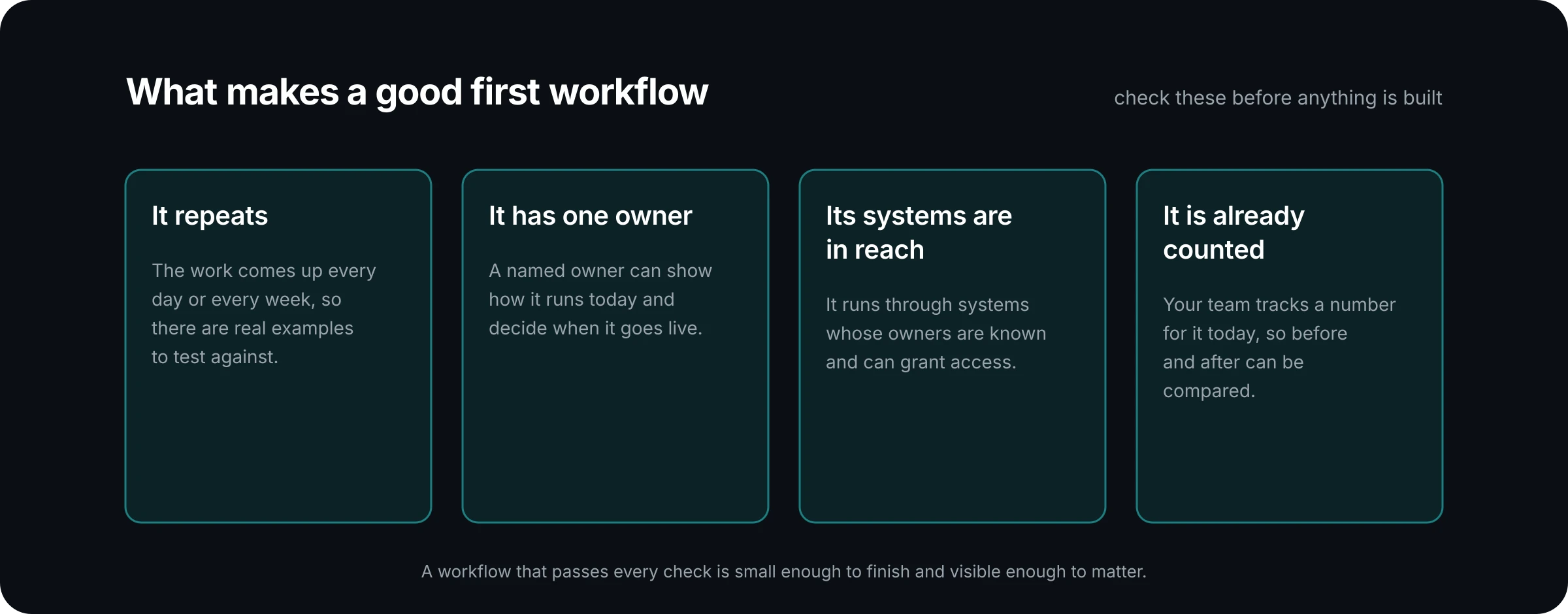
It repeats. Work that comes up every day or every week gives you real examples to test against and enough volume to see a change. A task that happens twice a year is hard to build for and harder to judge.
It has one owner. There is a person who can show how the work is done today and who has the authority to say when the new version goes live. If three teams share the work and none of them owns it, settle that first.
Its systems are in reach. The work runs through systems you control or can get access to, such as the PSA, the CRM, the ITSM tool, email and files. Each of those systems has an owner who can grant access. A workflow that depends on a system nobody can open up is a poor place to start.
It is already counted. Your team tracks a number for this work today. That gives you a before, which is the only way to have an after.
A workflow that passes all four is small enough to finish and visible enough to matter.
Why does it need one owner?
A workflow without an owner has nobody to answer three questions that come up in every build: how is this really done today, is the new version good enough, and when does it go live.
The owner is rarely the most senior person. It is the person who answers for the work: the service desk manager for ticket intake, the sales operations lead for quote assembly, the renewals manager for renewals. They know the exceptions that never made it into the process document, and they are the one whose week changes when the workflow goes live.
One owner also keeps the scope honest. When a second team asks for the workflow to cover their case too, the owner decides whether that belongs in this build or the next one.
What makes a good measure?
A good measure is an operating number, it already exists, and the workflow can plausibly move it.
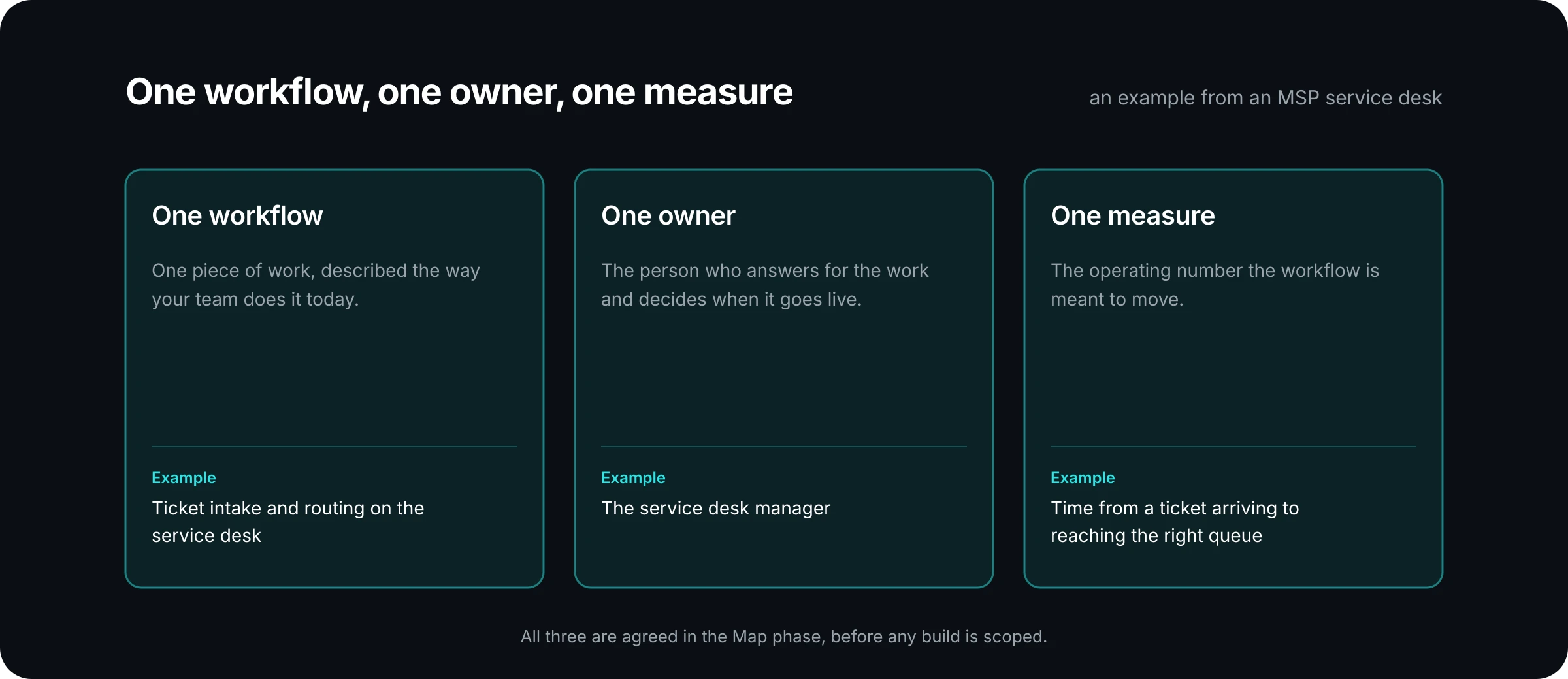
Take a service desk that wants help with ticket intake and routing. The measure could be the time from a ticket arriving to reaching the right queue, or the share of tickets that are reassigned after first routing. Both are numbers the PSA can already report. Both move if routing gets better.
Compare that with "improve efficiency" or "save time". Neither can be checked on a given Friday. If the measure cannot be read off a report your team already runs, it will be argued about later.
Choose one. A workflow with five measures has none, because any result can be read as a success on one of them.
Which workflows do channel businesses usually consider first?
The right answer depends on your business, but some candidates come up often because they pass the four checks.
For an MSP: ticket intake, classification and routing; drafting client updates for a technician to approve; preparing a recurring business review from PSA, ticket and project data; generating the task list for a new client onboarding.
For a solution provider: turning discovery notes into a scope summary; assembling a quote package from CRM data, vendor inputs and earlier templates; drafting a proposal for the rep and an engineer to approve; the handoff from sales to delivery after a deal closes.
Notice what these have in common. The agent drafts, summarises, routes and checks. A person approves anything that reaches a client or changes a commercial record. That pattern makes a first workflow safe to run, and approvals and permissions are how it is enforced.
What should wait until later?
Some work is worth doing but makes a poor start.
Leave work that is rare, because there is too little of it to test or measure. Leave work that crosses several teams with no single owner. Leave work where the process itself is in dispute, because an agent built on an unsettled process only makes the disagreement run faster. And leave anything where a wrong action cannot be undone and no person sits in front of it.
A useful output from any planning session is a short list of what not to automate yet, with the reason beside each item. It stops the same idea coming back every month.
How do you agree it before a build starts?
Write three things down and have the owner sign them off: the workflow, described the way the team does it today; the owner, by name; and the measure, with its current value.
This is how PRESHai starts every build. In the Map phase, your team shows us how the work is done today, and you decide the first workflow, its owner and its measure. What you receive is a sequenced roadmap: which workflow comes first, what each one depends on and who owns it. The strategy and roadmap page covers what we look at, and how we work shows what follows in each phase.
Alongside those three, every engagement also names the system of record, what each agent may read and change, and how much your team will run itself afterwards.
Where to start
List the candidates. Run each through the four checks. For the one that passes, name the owner and write down today's number. That is a morning's work, and it turns "we should do something with AI" into a build someone can scope.
If you would like a second view on the shortlist, show us the work. We will talk through who should own it, how to measure it and what is practical to build.